


Imperial China, Axial Age, illustrated history of China
Have you ever wondered what was happening on the other side of the world while the pyramids of Egypt were rising, the philosophers of Athens were debating, or the legions of Rome were marching?
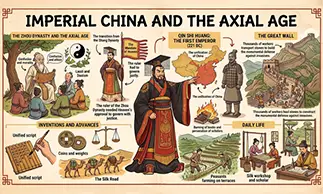
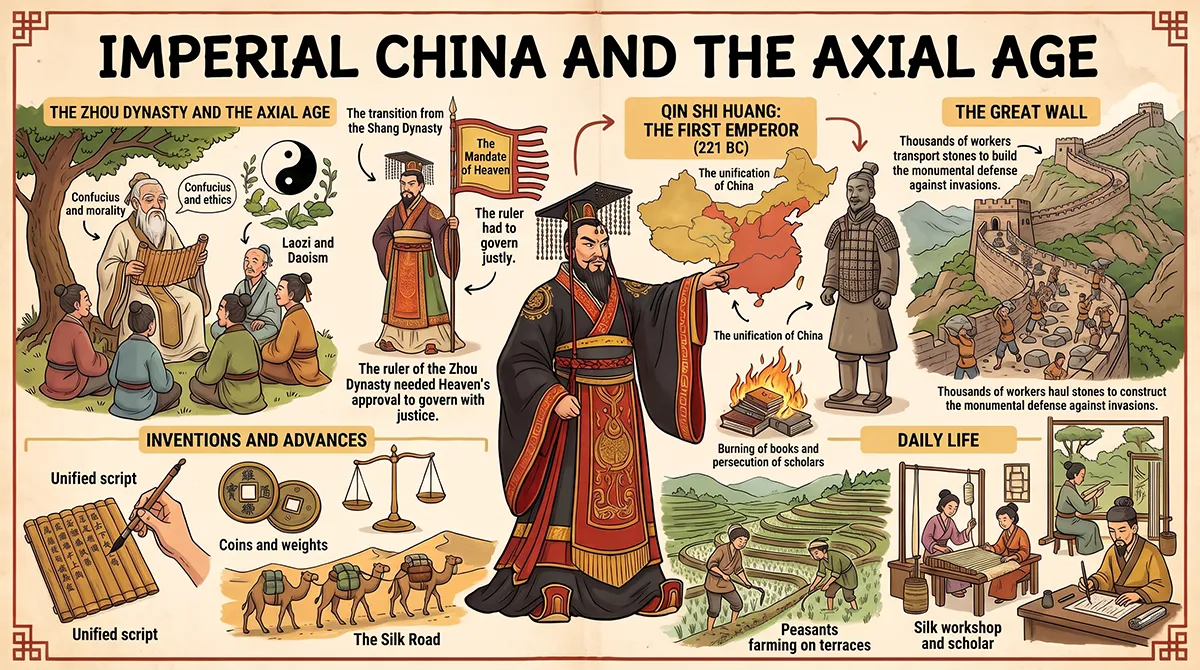
Journey for the first time to the heart of Asia to discover a civilization as fascinating as it is often overlooked in the West: ancient China. From the mythical Mandate of Heaven of the Zhou Dynasty and the great philosophical awakening of Confucius and Laozi, to the iron fist of Qin Shi Huang—the First Emperor who unified the country, built the colossal Great Wall, forged an immortal Terracotta Army, and opened the gates of the legendary Silk Road. Explore this illustrated chapter step by step and discover how East and West together shaped the history of humanity.
1. The Zhou Dynasty (1046 – 256 BC): The Origin of Feudalism in China
The Zhou Dynasty presided over one of the longest and most crucial periods in Chinese history, laying the foundations of its territorial and social organization for nearly eight hundred years
-
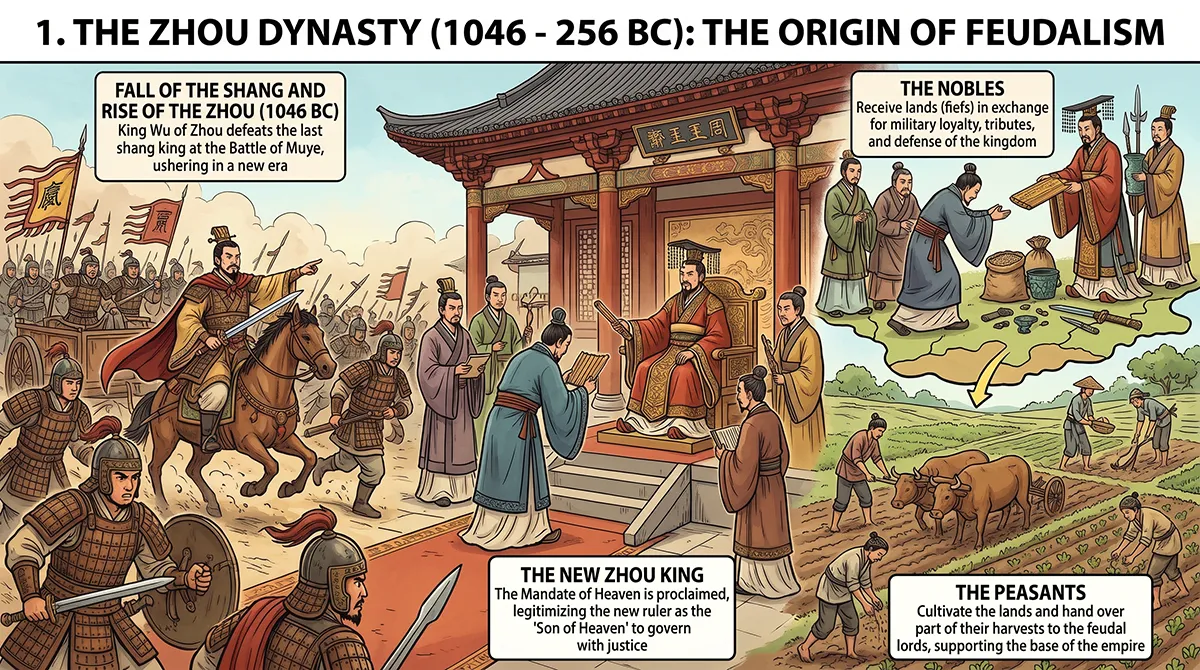
The Fall of the Shang and the Rise of the Zhou (1046 BC): After years of tyranny and decline under the Shang Dynasty, King Wu of Zhou led a coalition of allied peoples. The decisive clash took place at the famous Battle of Muye (1046 BC), where Zhou forces, despite being outnumbered, defeated the Shang army. The last Shang king took his own life, and King Wu assumed control, inaugurating a new era and moving the capital near present-day Xi’an.
-
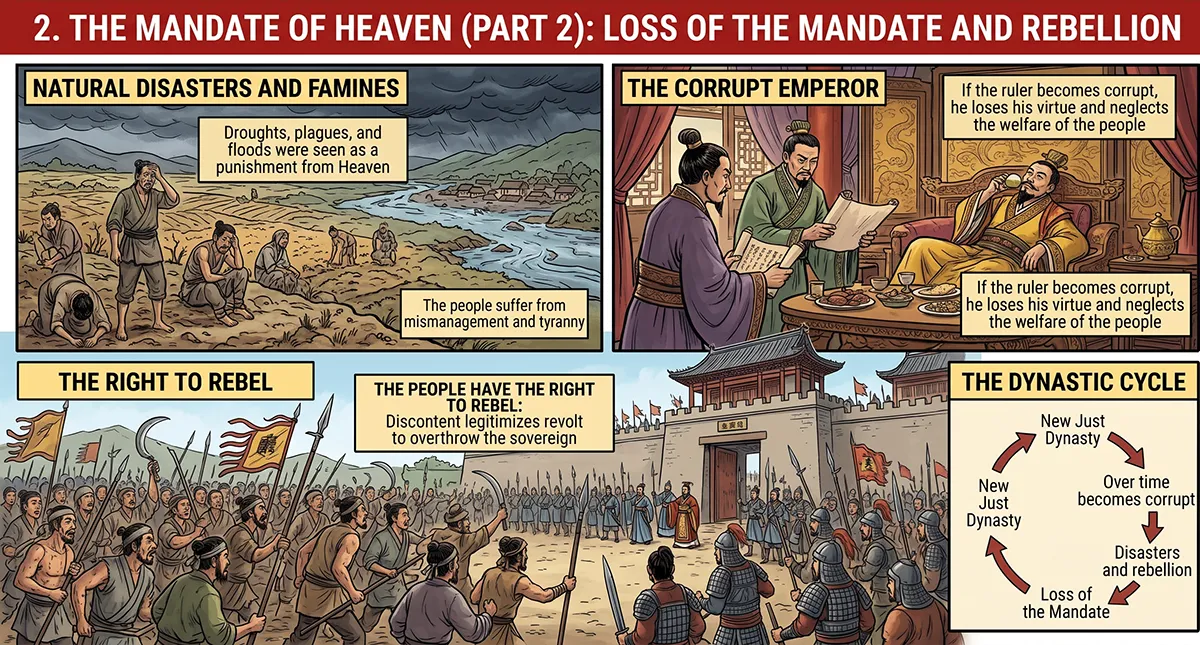
The New Zhou King and Divine Legitimacy: To justify the overthrow of the Shang to their subjects, the Zhou introduced a revolutionary idea: the Mandate of Heaven (Tianming). According to this belief, the ruler was the “Son of Heaven,” chosen by a cosmic force to govern with justice. If he fell into corruption or tyranny, Heaven withdrew its favor—manifested through natural disasters, revolts, or military defeats—thereby legitimizing the people to rise up and a new virtuous leader to seize power.
-
The Feudal System (Fengjian): Faced with an immense territory that was difficult to govern directly, the Zhou king implemented a decentralized system of governance remarkably similar to the European feudalism that would emerge centuries later:
-
The Nobles: The king divided the empire into fiefs or states and granted them to relatives, allies, and trusted generals. In exchange for these lands, feudal lords swore absolute loyalty to the sovereign, paid tributes (in grain, metals, and goods), and supplied soldiers and war chariots in times of war.
-
The Peasants: At the base of this pyramid stood the peasant population. They worked the land under the “well-field” system (jingtian), cultivating outer plots for their own sustenance and collectively tilling the central plot, whose entire harvest belonged to the feudal lord. They were also obligated to perform public labor, such as building roads and walls, and to serve in the army when summoned.
-
This system functioned successfully for centuries, allowing borders to expand and the region to unify culturally, until the power of the feudal lords grew so great that it began to rival that of the Zhou king himself, sowing the seeds of future conflicts.
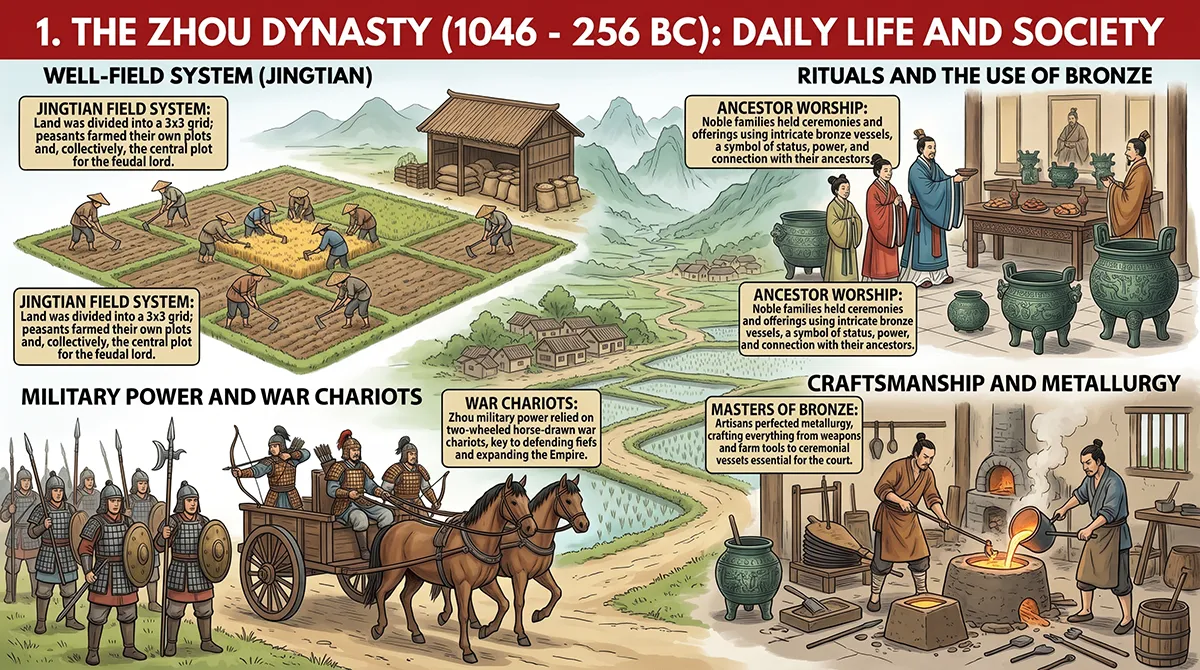
In this illustration, we can observe daily life during the Zhou Dynasty, the structure of the community, and its material and spiritual advancements:
-
Well-Field System (Jingtian): Visually illustrates an ingenious feudal land-distribution model based on a 3×3 grid, where the community collectively cultivated the central plot for the lord, while the remaining plots were used for their own subsistence.
-
Ancestor Worship and Rituals: This depicts a noble offering ceremony featuring the renowned and elaborate bronze vessels and bells—elements fundamental to their complex worldview and the legitimacy of their lineage.
-
Military Power and War Chariots: Highlights the importance of horse-drawn chariot technology, which was essential for expansion and for defense against nomadic peoples along the borders.
-
Craftsmanship and Metallurgy: Illustrates the laborious process of bronze casting in specialized workshops, revealing the origins of their tools, weapons, and ritual objects.
2. The Mandate of Heaven (Tianming): The Legitimacy to Rule
The Mandate of Heaven (Tianming) is one of the most consequential concepts in world history, serving as the ethical, political, and religious pillar that justified the rise and fall of Chinese dynasties for more than three thousand years. Introduced by the Zhou to legitimize the overthrow of the Shang Dynasty, it became a universal rule: absolute power carried absolute moral responsibility.
Part One: The “Son of Heaven” and the Duty of Virtue
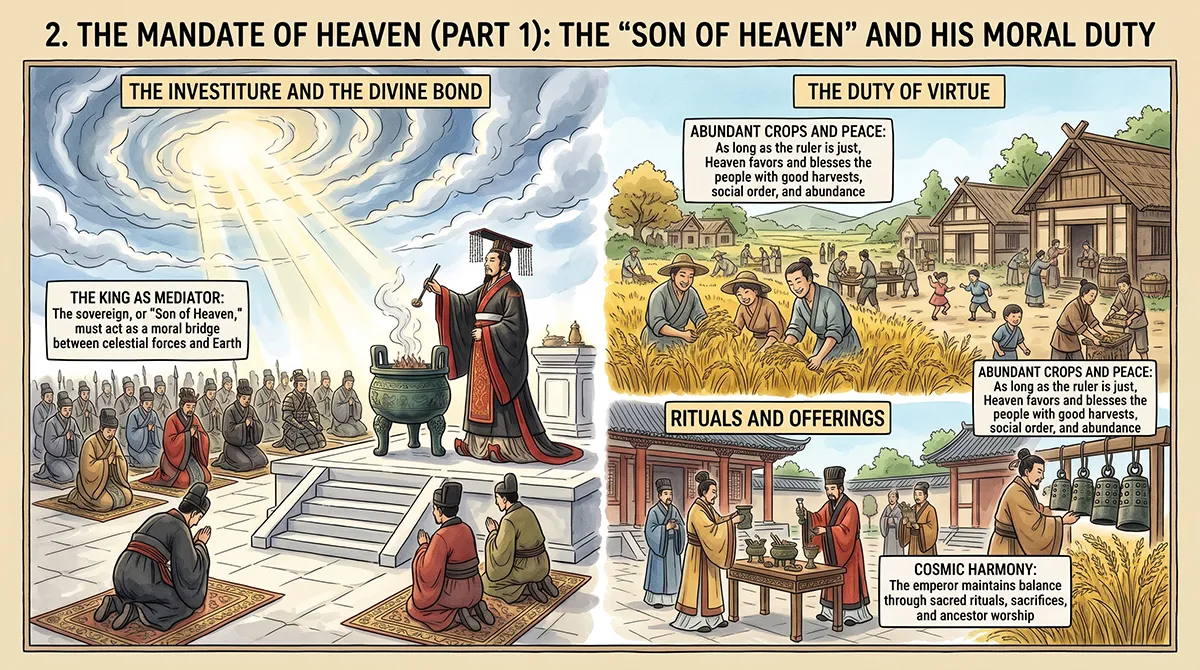
To the ancient Chinese, the ruler was not a god himself, but the Son of Heaven (Tianzi), an earthly mediator chosen by a supreme cosmic and moral force called Tian (Heaven). This divine favor was not a permanent birthright or bloodline privilege, but a moral loan conditioned on the sovereign’s conduct.
-
Virtue as a Requirement: The sovereign had the duty to govern with justice, care for his people, and maintain harmony between Heaven and Earth through rigorous rituals and offerings. If the ruler was compassionate and wise, society prospered, and Heaven blessed the empire with abundant harvests, peace, and stability.
-
The Dynamics of the Dynastic Cycle: A good emperor passed the mandate down to his children, but if the lineage grew corrupt, fell into greed and tyranny, or neglected affairs of state, its legitimacy steadily eroded.
3. The Axial Age and the Hundred Schools of Thought: The Great Philosophical Awakening
Between the 8th and 3rd centuries BC, while the Zhou feudal system fractured and the ancient world entered a period of deep crisis, an astonishing phenomenon took place: far from sinking into darkness, China experienced the greatest intellectual and philosophical explosion in its history. This golden age of thought is known as the era of the Hundred Schools of Thought (Zhuzi Baijia), a creative burst that coincided with what historians call the global Axial Age.
Part One: Political Crisis and Connection with the World (The Axial Age)
-
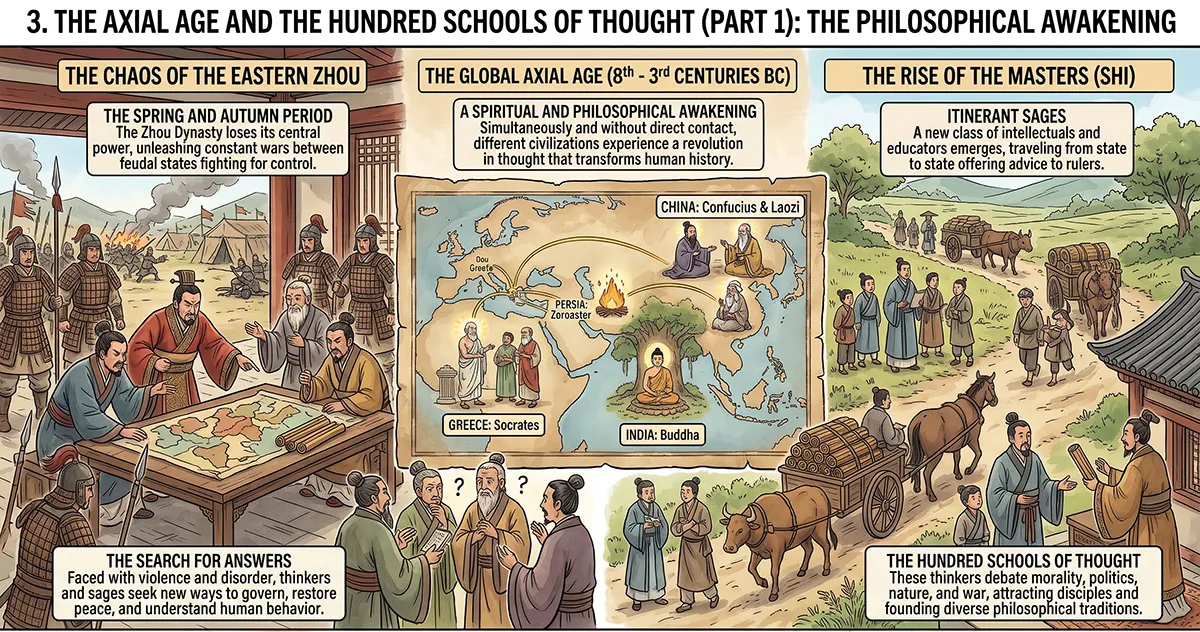
From Feudal Order to the Chaos of Spring and Autumn (770 – 476 BC): Over the centuries, Zhou kings lost authority to their former vassals. Feudal lords stopped obeying the king, declared independence, and began fighting one another for land, resources, and prestige. Amid this turmoil, thousands of former officials, scribes, and impoverished nobles—known as the Shi (itinerant scholars)—found themselves out of work and began traveling from kingdom to kingdom offering advice on how to restore peace and good governance.
-
A Simultaneous Global Phenomenon (The Axial Age): German philosopher Karl Jaspers coined the term Axial Age (“pivot” of human history) for this period (between 800 and 200 BC) because, almost simultaneously and without direct contact, major thinkers emerged across Eurasia who shaped the moral conscience of humanity:
-
In China: Confucius, Laozi, Mozi, and Mencius sought social order and cosmic harmony.
-
In Greece: Socrates, Plato, and Aristotle laid the foundations of rational philosophy and democracy.
-
In India: Siddhartha Gautama (Buddha) and Mahavira revolutionized spirituality and compassion.
-
In Persia and the Near East: Zoroaster and the Hebrew prophets redefined ethics and divine justice.
-
Part Two: The Great Debate of the Hundred Schools (and the Jixia Academy)
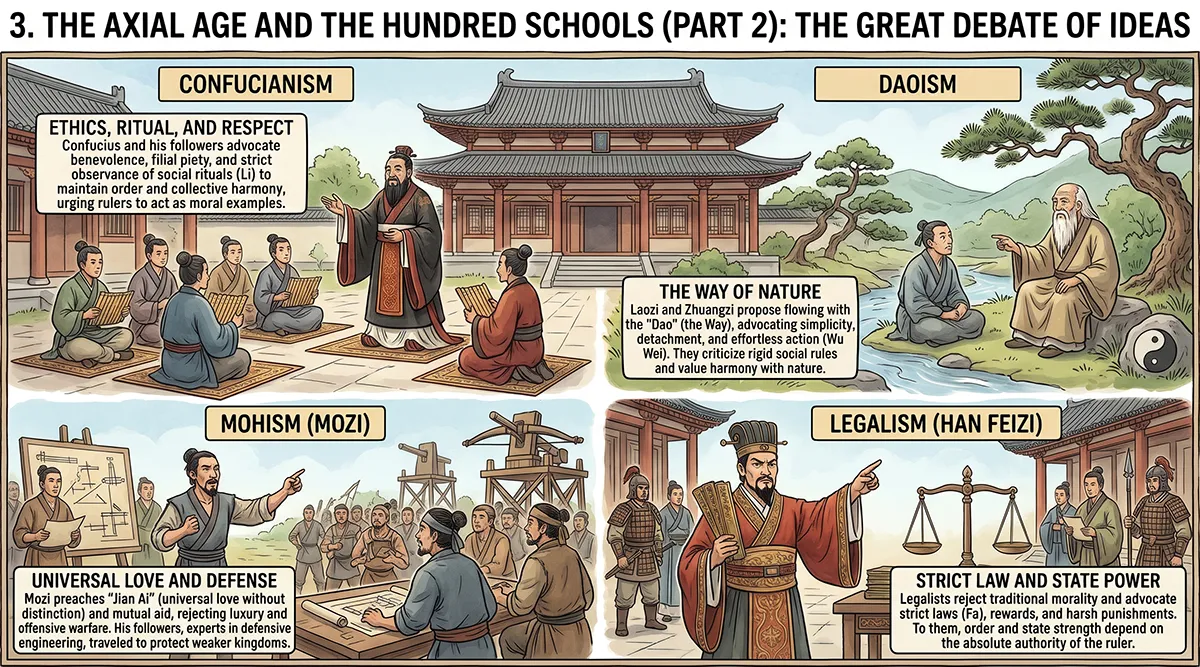
The expression “Hundred Schools” does not mean there were literally one hundred doctrines, but rather an extraordinary diversity of masters, disciples, and open debates. Rulers of rival states competed to attract the finest sages to their courts; the most famous example was the Jixia Academy in the state of Qi, a true ancient “university” where hundreds of thinkers received stipends and lodging simply to debate freely.
Although dozens of currents flourished (such as the School of Names, focused on logic, or the School of Yin-Yang, centered on cosmology), four major visions dominated the debate on how to heal a broken world:
The Four Great Schools of Thought
Four distinct answers to the same question: how to restore peace and order to a world at war?
| Philosophical School | Key Figures | Core Idea | How to Achieve Peace |
|---|---|---|---|
| 📜 Confucianism | Confucius Mencius | Ethics, education, and moral duty (Ren). | Through virtuous rulers who lead by example and respect for family and social hierarchies. |
| ☯️ Daoism | Laozi Zhuangzi | Harmony with nature and the flow of the universe (Dao). | By abandoning ambition, artificial laws, and force; governing with simplicity and non-interference (Wu Wei). |
| 🛡️ Mohism | Mozi | Universal love (Jian Ai) and pacifist pragmatism. | By loving everyone equally without distinction of family or class, condemning wars of conquest, and eliminating wasteful luxury. |
| ⚖️ Legalism | Shang Yang Han Feizi | Political realism, authority, and strict laws (Fa). | By assuming humans are selfish by nature and controlling society through strict laws, rewards, and harsh punishments. |
-
The Impact of Mozi and the Pacifist Engineers: Less known outside Asia yet fascinating to any reader, Mozi founded a tightly organized school that criticized both Confucian ritual elitism and the lavish spending of nobles. His followers not only preached universal love, but were also brilliant military engineers specializing exclusively in defensive techniques: they traveled to small cities under attack by powerful kingdoms to help fortify their walls and deter invaders.
-
The Seed of the Future Empire: While Confucians, Daoists, and Mohists appealed to conscience or nature, the Legalists offered kings a fast, effective formula to accumulate military and agricultural power. This rivalry of ideas was no mere academic exercise: it would determine which kingdom conquered the rest and which model governed China for the next two millennia.
4. Confucius and Social Order: The Foundations of Chinese Society
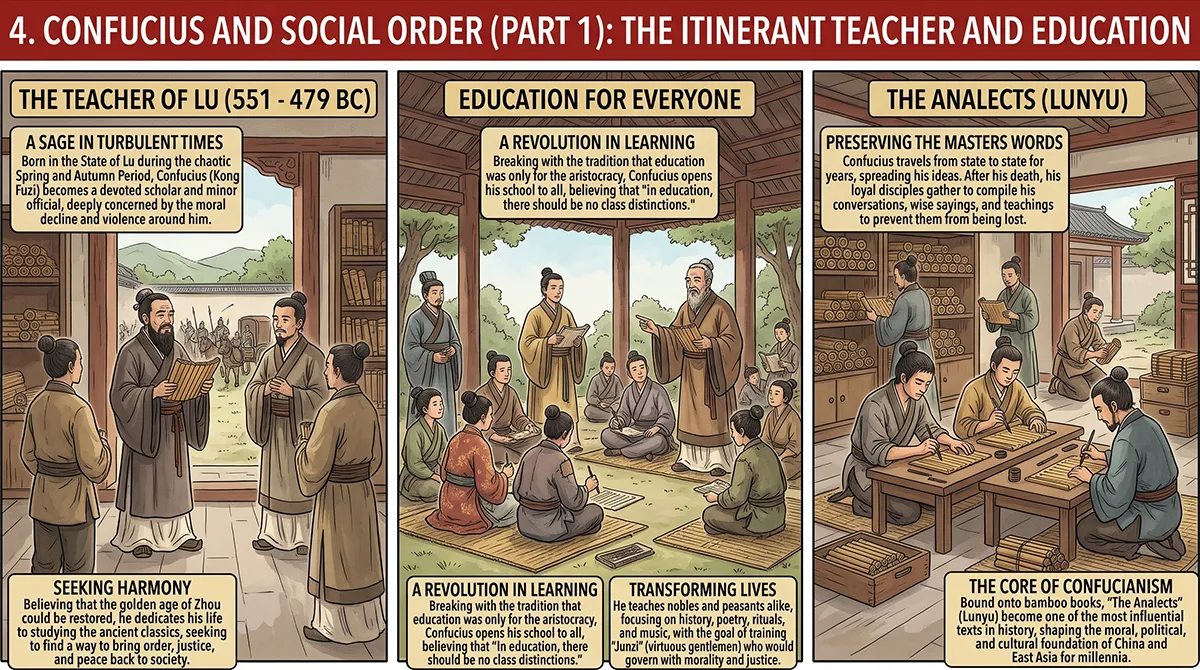
Few thinkers in history have shaped the daily lives, family structure, and education of an entire civilization as deeply as Confucius (Kong Fuzi, or “Master Kong”, 551 – 479 BC). Living during a turbulent era when nobles broke treaties and kingdoms fought endlessly, Confucius did not claim to be a prophet or a god, but a teacher determined to restore peace through moral cultivation and education.
Part One: The Itinerant Teacher and the Value of Education
-
The Teacher of Lu (551 – 479 BC): Born in the small state of Lu (modern-day Shandong Province) to an impoverished aristocratic family, Confucius worked as a minor clerk in granaries and pastures before becoming a respected scholar and magistrate. Disillusioned when rulers preferred military conquest over ethical governance, he left his post and spent more than twelve years traveling from kingdom to kingdom with his disciples, offering wise counsel to any prince willing to listen.
-
Education for Everyone: Until that time, formal education—reading, writing, history, music, and archery—was a privilege reserved exclusively for the children of the nobility. Confucius broke that barrier by opening his school to any young person eager to learn, regardless of social class or wealth, asking only for sincerity and effort in return.
-
The Analects (Lunyu): Confucius never wrote a book of his own. After his death, his loyal disciples compiled his conversations, aphorisms, and teachings into a concise, profound volume titled The Analects (Lunyu), which became the most studied moral and political textbook across East Asia for more than two millennia.
Part Two: The Pillars of Social Order and the Five Relationships
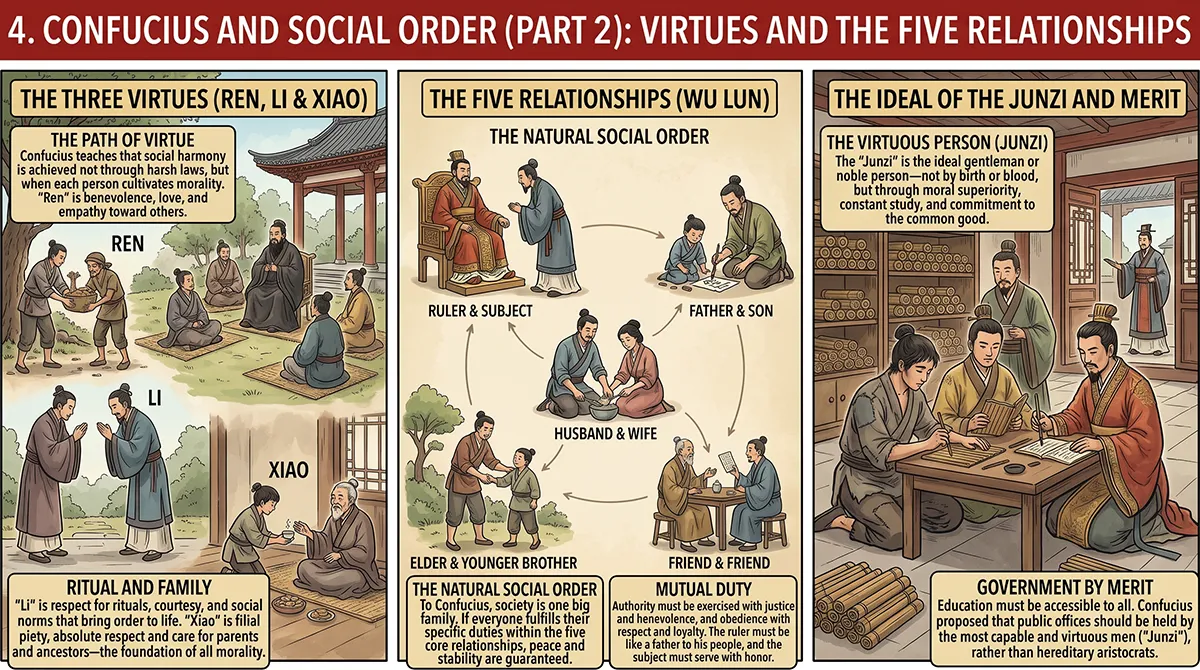
To Confucius, the peace of an entire empire does not begin in palaces or armies, but within each individual and each household. His blueprint for transforming a chaotic society into a harmonious community rested on three core virtues and a clear network of mutual respect:
-
The Three Great Confucian Virtues:
-
Ren (Benevolence and Humaneness): The supreme virtue. It consists of empathy, love for one’s neighbor, and compassionate treatment of others. Confucius summed it up in a famous Golden Rule: “Do not impose on others what you yourself do not desire.”
-
Li (Ritual and Propriety): Refers not only to sacred ceremonies, but to rules of courtesy, everyday respect, etiquette, and appropriate conduct in every social setting to prevent conflict.
-
Xiao (Filial Piety): Deep respect, devotion, and care toward one’s parents, elders, and ancestors. To Confucius, a person who learns to honor their parents at home will naturally respect the law and live peacefully in society.
-
-
The Five Core Relationships (Wu Lun): Confucius viewed society as a web of reciprocal bonds in which every person holds a specific role and moral duty toward the other:
-
Ruler and Subject: The ruler must be just and care for the people’s welfare; the subject must be loyal.
-
Father and Son: The father must guide and protect with kindness; the son must honor and care for his parents in old age.
-
Husband and Wife: Both must support each other while fulfilling their family responsibilities.
-
Elder Brother and Younger Brother: The elder must lead by good example; the younger must show respect and learn.
-
Friend and Friend: The only relationship between equals, founded on trust, sincerity, and mutual loyalty.
-
-
The Ideal of the Junzi (The “Virtuous Person”): Challenging the ancient belief that nobility was inherited by blood, Confucius taught that a true noble (Junzi) is anyone who refines their character through study, honesty, and virtue. Centuries later, this ideal inspired the famous Imperial Examinations, a meritocratic system allowing any citizen who mastered the classics to become a high-ranking state official.
5. Laozi and Daoism: Flowing in Harmony with Nature
If Confucius sought to heal society through rules, education, and civic duty, Laozi (“Old Master”) offered the exact opposite remedy: stepping back from artificial ambition, rigid laws, and the rat race of power to reconnect with the natural rhythm of the universe. Thus was born Daoism (or Taoism), the mystical and poetic counterpart to Chinese philosophy.
Part One: The Legend of Laozi, the Tao Te Ching, and the Dao
Unlike Confucius, whose life is well documented, the figure of Laozi is shrouded in mystery and legend:
-
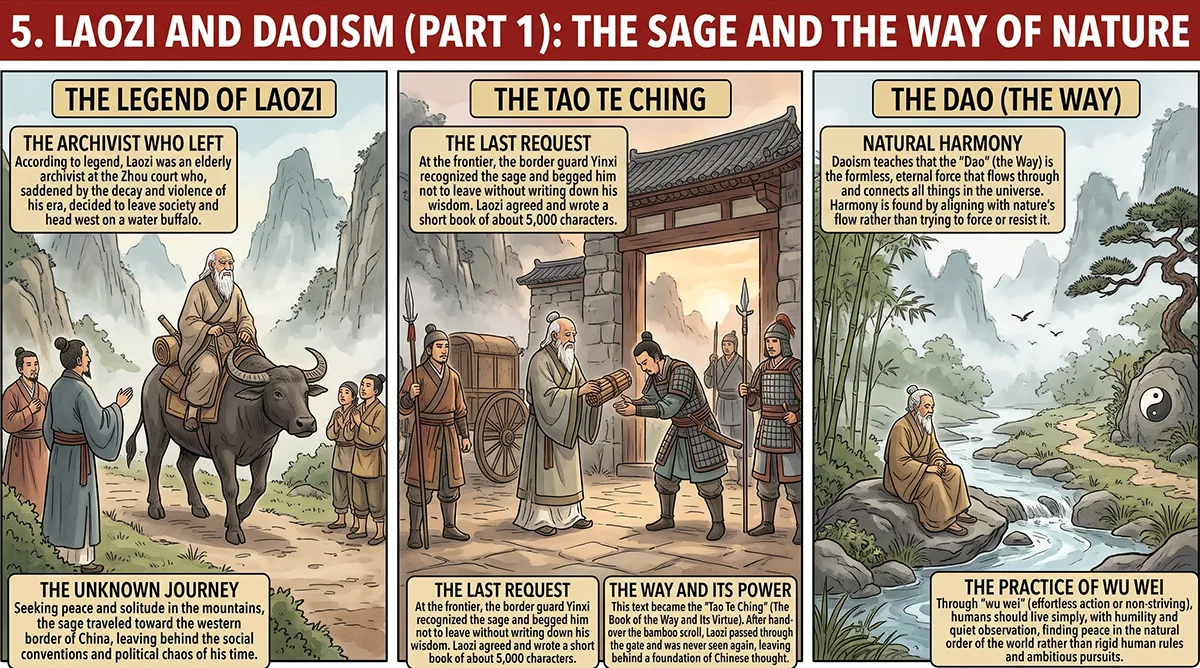
The Legend of the Archivist and the Water Buffalo: Historical details about Laozi’s life (traditionally placed in the 6th century BC) blend history and legend. He is said to have worked as keeper of the royal archives of the Zhou Dynasty, where even a young Confucius once visited him for advice. Disheartened by human corruption and endless warfare, the elderly white-bearded sage climbed onto a water buffalo and rode west toward the mountains to live as a hermit.
-
The Tao Te Ching (The Book of the Way and Virtue): Upon reaching the western mountain pass of Hangu, the border guard Yinxi recognized the sage and begged him to write down his wisdom before leaving civilization behind forever. Laozi paused for three days and composed a short, poetic masterpiece of barely 5,000 Chinese characters divided into 81 brief chapters: the Tao Te Ching, one of the most translated books in world literature.
-
The birth of a universal book (Tao Te Ching): Upon arriving at the Hangu border pass, the gatekeeper, Yinxi, recognized the renowned sage and implored him not to leave without committing his wisdom to writing. Lao-Tse agreed, stayed for a few days, and composed a brief text of barely 5,000 characters, divided into 81 short philosophical poems: the Tao Te Ching (The Book of the Way and Virtue). Immediately afterward, he crossed the border and vanished forever, leaving behind one of the most translated and influential books in the entire history of humanity.
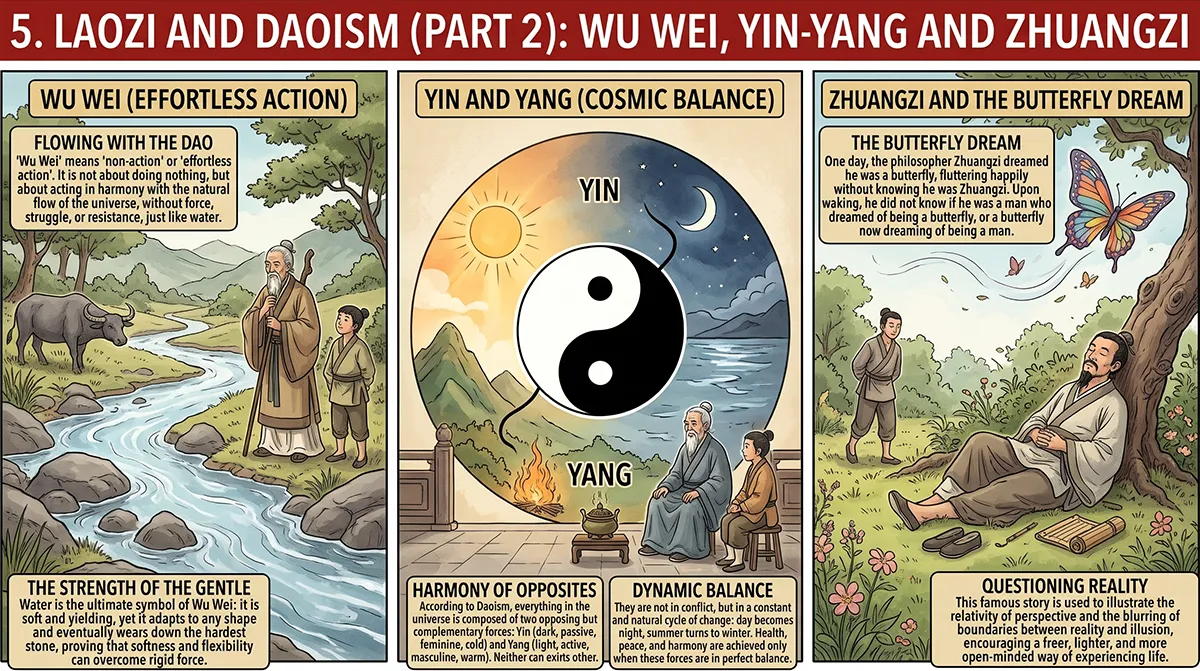
Part Two: The Pillars of Taoist Philosophy. Wu Wei, the Balance of Yin-Yang, and Zhuangzi.
Taoism invites us to observe how the universe functions without human intervention, in order to learn how to live without suffering or violence:
-
The Tao (The Way): The Tao is not a god in human form, but rather the invisible, eternal, and natural force that gives rise to all things and keeps them in motion. It is the spontaneous order of the universe—the cycle of the seasons, the growth of plants, or the course of rivers. For Taoists, human problems arise when individuals attempt to impose themselves upon the Tao through artificial ambitions and rigid laws.
-
The Harmony of Yin and Yang: Daoist thought embraced the ancient cosmic principle that everything in nature consists of two complementary, interconnected forces rather than warring enemies:
-
Yin: Dark, cool, receptive, moon, water, stillness, valley.
-
Yang: Bright, warm, active, sun, fire, movement, mountain.
-
Neither can exist without the other—night gives way to day, winter to spring—and each carries a seed of its opposite within itself.
-
-
Wu Wei (Effortless Action or Non-Interference): Wu Wei does not mean sitting around doing nothing; it means acting without strain, violence, or arrogance, aligning with the natural flow of events. Laozi loved the metaphor of water: water is the softest and most yielding substance on Earth, yet over time it wears away the hardest stone. Likewise, the best ruler governs with simplicity and minimal interference, allowing people to thrive naturally.
-
Legacy in world culture: Later, the philosopher Zhuangzi (4th century BCE) expanded upon these ideas through stories filled with humor and paradoxes (such as his famous dream, in which he could not tell whether he was a man dreaming he was a butterfly, or a butterfly dreaming he was a man). Over time, Taoism profoundly shaped Chinese landscape art, traditional medicine, “soft” martial arts (such as Tai Chi), and modern ecological consciousness.
6. The Warring States Period (475 – 221 BC): The Era of Great Wars and Military Transformation
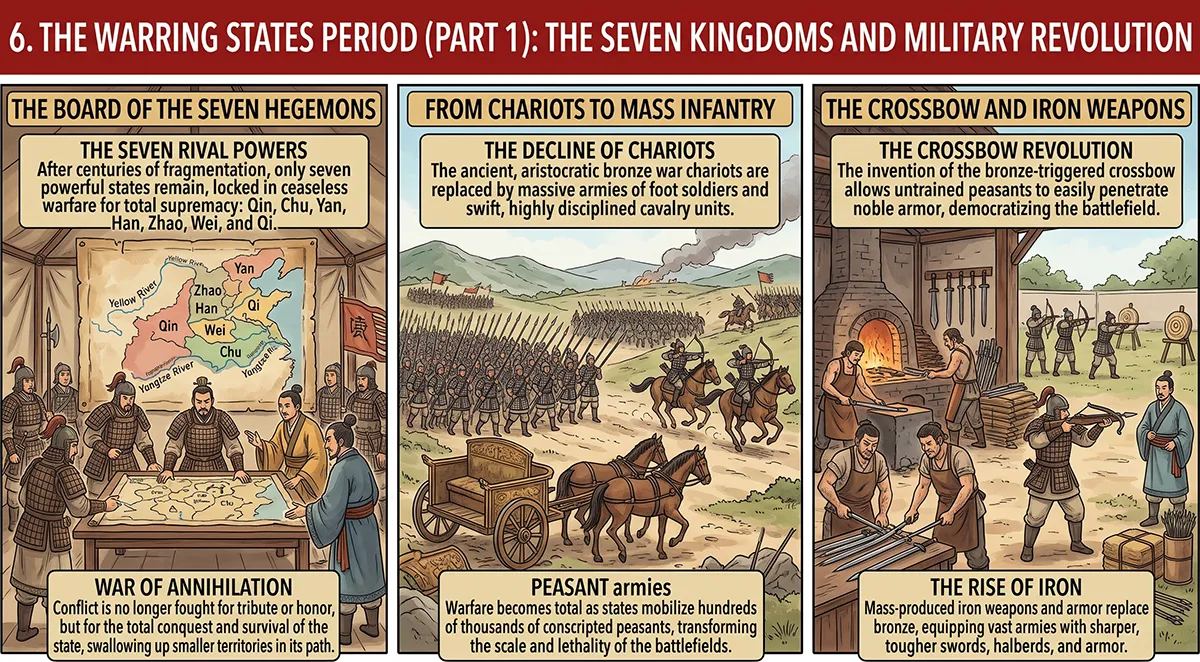
By the 5th century BC, the old feudal etiquette of the Zhou Dynasty had completely collapsed. Dozens of small principalities had been swallowed up by their stronger neighbors, leaving only seven major rival kingdoms locked in a ruthless struggle for survival and total supremacy: Qin, Chu, Qi, Yan, Han, Wei, and Zhao. During these two and a half centuries of relentless warfare, China underwent a profound military, technological, and diplomatic revolution.
Part One: The Board of the Seven Kingdoms and the Military Revolution
-
The Board of the Seven Hegemons (Zhanguo Qixiong): Each state had its own strategic advantages. Chu in the south was vast and rich in resources; Qi in the east prospered from salt and coastal trade; Zhao in the north developed agile cavalry to fight steppe nomads; and Qin in the mountainous west built a disciplined war machine fueled by Legalist reforms.
-
From Aristocratic Chariots to Mass Infantry: In earlier centuries, battles were fought by nobles riding two-wheeled bronze chariots under strict codes of chivalry. During the Warring States period, wars became total conflicts involving hundreds of thousands of conscripted peasant infantrymen, supported by newly adopted cavalry units inspired by northern nomads.
-
The crossbow, the ultimate weapon: The introduction of the crossbow (*nu*)—featuring bronze trigger mechanisms—represented a true technological revolution. It enabled a peasant with only a few days of training to pierce the armor of a noble warrior from a distance. The mass production of these weapons and the use of standardized arrowheads industrialized warfare.
-
Cavalry and Iron: In the face of incursions by nomads from the north, kingdoms such as Zhao adopted the attire and tactics of mobile cavalry, replacing chariots with swift, bow-wielding horsemen. Furthermore, iron metallurgy supplanted bronze in the production of swords, spears, and armor, rendering these weapons and gear far more lethal—and more accessible to the masses of combatants. Total War and the Technology of the Warring States
Part Two: Strategy, Diplomacy (The Art of War), and the Rise of Qin
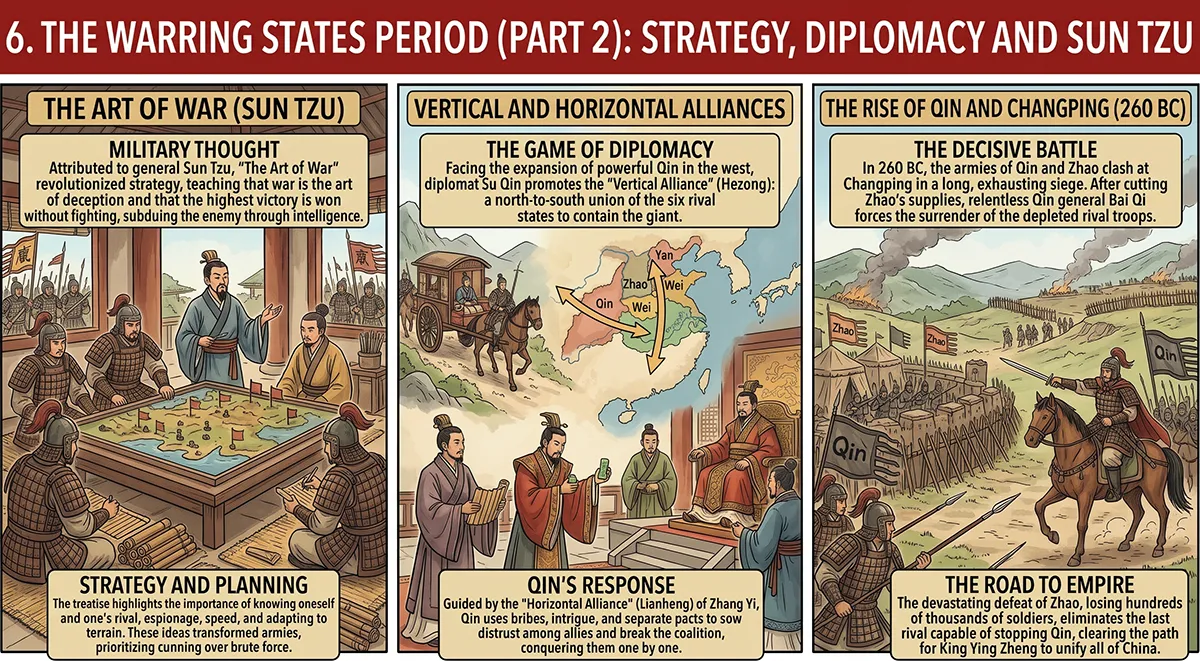
In an arena where seven powers balanced one another, winning on the battlefield was not enough: intelligence, espionage, and diplomatic alliances became just as decisive as iron swords.
-
The Art of War and Military Science: Chinese strategic literature reached its peak during this era, led by the famous treatise The Art of War (attributed to Sun Tzu and expanded by later strategists such as Sun Bin). Rejecting reckless frontal assaults, these masters taught that warfare was a matter of calculation, psychology, and logistics: “Supreme excellence consists of breaking the enemy’s resistance without fighting.” Generals studied terrain, deployed spy networks, and used deception to strike only when victory was assured.
-
The Vertical (Hezong) and Horizontal (Lianheng) Alliances: As the western kingdom of Qin grew stronger through its Legalist reforms, the other six states tried to stop it through an intricate game of diplomacy:
-
The Vertical Alliance (Hezong): Championed by strategists like Su Qin, it sought to unite the six eastern kingdoms from north to south (Yan, Zhao, Han, Wei, Qi, and Chu) into a common front against Qin.
-
The Horizontal Alliance (Lianheng): Devised by diplomats serving Qin such as Zhang Yi, it relied on bribery, intimidation, and bilateral promises of territory to fracture the coalition and turn the six states against one another. Ultimately, Qin’s horizontal diplomacy dissolved its rivals’ unity.
-
-
The Battle of Changping (260 BC) and the Point of No Return: The greatest clash of the entire era pitted the two strongest armies against each other: Qin versus Zhao. After nearly three years of trench warfare and stalemate, Qin spies persuaded the king of Zhao to replace his veteran general Lian Po with a young, inexperienced commander, Zhao Kuo. Qin general Bai Qi feigned a retreat, lured the Zhao army into a trap, and severed its supply lines for 46 days. Zhao’s defeat was catastrophic, leaving no other kingdom strong enough to halt Qin’s future imperial conquest.
7. Qin Shi Huang, the First Emperor (221 BC): The Birth of China
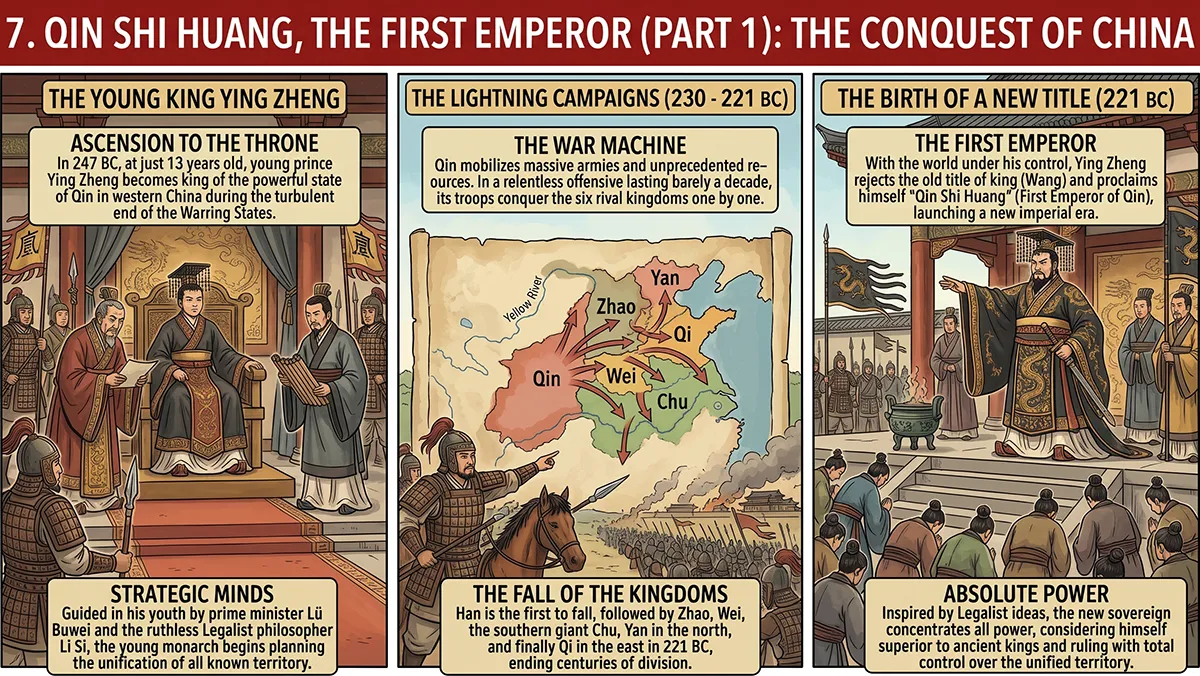
After more than two and a half centuries of constant warfare among the Warring States, a single state triumphed over all the rest and changed the history of Asia forever. The architect of that feat was Ying Zheng, the ambitious king of Qin—a relentless ruler who in 221 BC unified the territory for the first time and invented a brand-new title for himself: Qin Shi Huang, the First Emperor of China (from whose kingdom, Qin, the Western name “China” derives).
Part One: From Boy King to Unifier of the Known World
-
Ascension to the Throne at Age 13 (247 BC): Ying Zheng inherited the crown of Qin as a teenager. During his early years, government affairs were managed by his mother and the powerful prime minister Lü Buwei, but upon turning 22 the young monarch seized absolute power, crushed a palace coup, and surrounded his court with brilliant Legalist strategists—chief among them his grand counselor, Li Si.
-
Qin’s War Machine: Protected by mountains in the west, Qin enjoyed natural defensive geography alongside a strict Legalist system that rewarded military merit and agricultural output over noble birth. This enabled it to field a disciplined army of hundreds of thousands of soldiers equipped with mass-produced iron weapons and crossbows.
-
Nine Years of Lightning Campaigns (230 – 221 BC): Applying the strategy of “befriending distant states while attacking nearby ones” and combining espionage with overwhelming force, Qin absorbed its six rival kingdoms one by one in a breathtaking decade: first fell Han (230 BC), then Zhao (228 BC), Wei (225 BC), the southern giant Chu (223 BC), Yan (222 BC), and finally Qi (221 BC).
-
A Title Fit for a God (Shi Huangdi): Seeing that no mortal had ever ruled so vast a realm, Ying Zheng felt the traditional title of “king” (Wang) was far too modest. He combined the words Huang (august) and Di (divine sovereign, previously reserved for mythical ancient emperors) to proclaim himself Shi Huangdi (“First Emperor”). He intended for his dynasty to endure for ten thousand generations—calling himself “First,” his successor “Second,” and so on into eternity.
Part Two: The Centralized State and the Obsession with Immortality
Conquering the map by force was only the beginning; the true challenge lay in preventing such a gigantic empire from fracturing again as it had under the Zhou Dynasty.
-
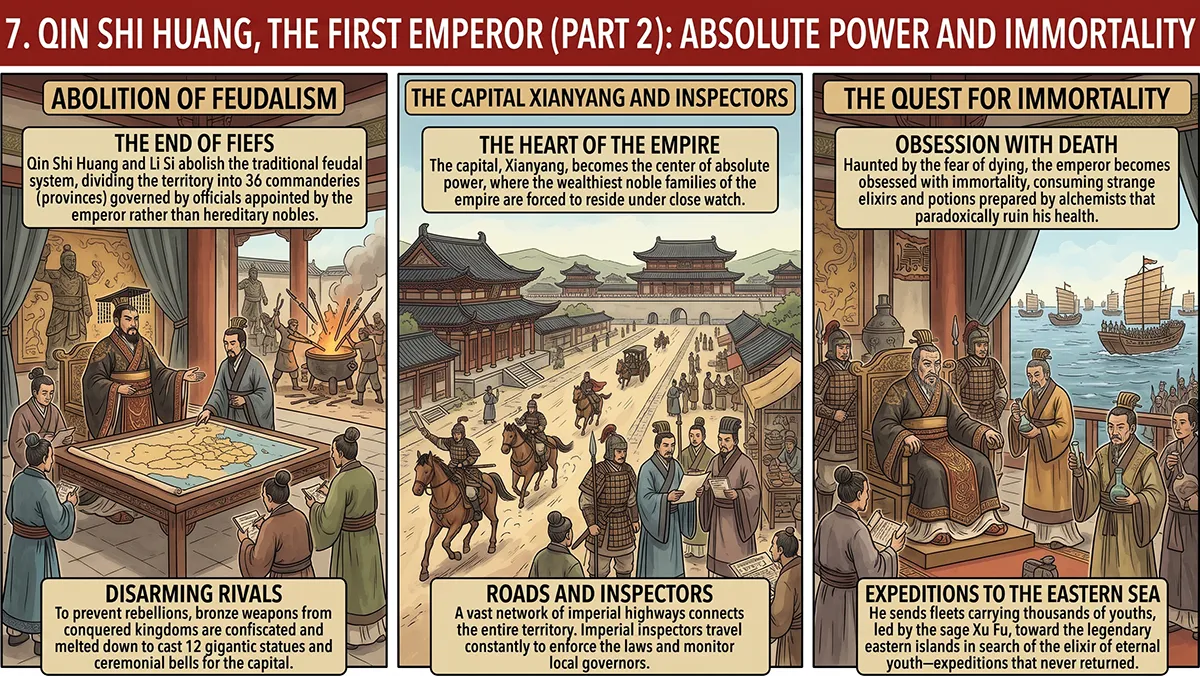
The End of Feudalism and the 36 Commanderies: On Li Si’s advice, Qin Shi Huang abolished the old feudal system at its roots. Instead of granting land to hereditary nobles who might rebel in the future, he divided the entire empire into 36 commanderies (provinces) governed by civil and military officials appointed directly by the emperor and rotated regularly. He also ordered all weapons across the empire confiscated and melted down to cast giant bells and twelve colossal bronze statues for his palace.
-
The Capital Xianyang and Imperial Highways: He forced more than 120,000 noble families from the conquered kingdoms to relocate to his capital, Xianyang, so he could keep them under close surveillance. To control every corner of the realm, he built a radial network of over 6,800 kilometers (4,200 miles) of imperial highways with central lanes reserved exclusively for imperial messengers, and constantly toured his empire in secret convoys to inspect local officials undetected.
-
Fear of Death and the Elixir of Life: After surviving several assassination attempts (including the famous plot by the assassin Jing Ke), the First Emperor grew deeply paranoid. Obsessed with ruling forever, he dispatched massive maritime expeditions toward the legendary islands of the immortals in the Eastern Sea (such as Xu Fu’s fleet carrying thousands of young men and women) and filled his court with alchemists. Ironically, the “immortality” pills prescribed by his physicians contained high doses of mercury—a slow poison that destroyed his health and caused his sudden death during an inspection tour in 210 BC at the age of 49.
8. Unification and Standardization: The Glue That Held China Together
Conquering the six rival kingdoms had cost decades of blood and iron, yet Qin Shi Huang and his brilliant prime minister Li Si knew that so vast an empire would collapse within a few years if its inhabitants could not understand one another, trade smoothly, or travel easily. In 221 BC, every former kingdom had its own laws, its own coins, its own measurements, and even its own way of writing Chinese characters.
To turn that patchwork of peoples into a single cohesive nation, the First Emperor launched one of the most ambitious administrative and cultural reforms in ancient history: standardizing absolutely everything.
Part One: One Script and One Currency
-
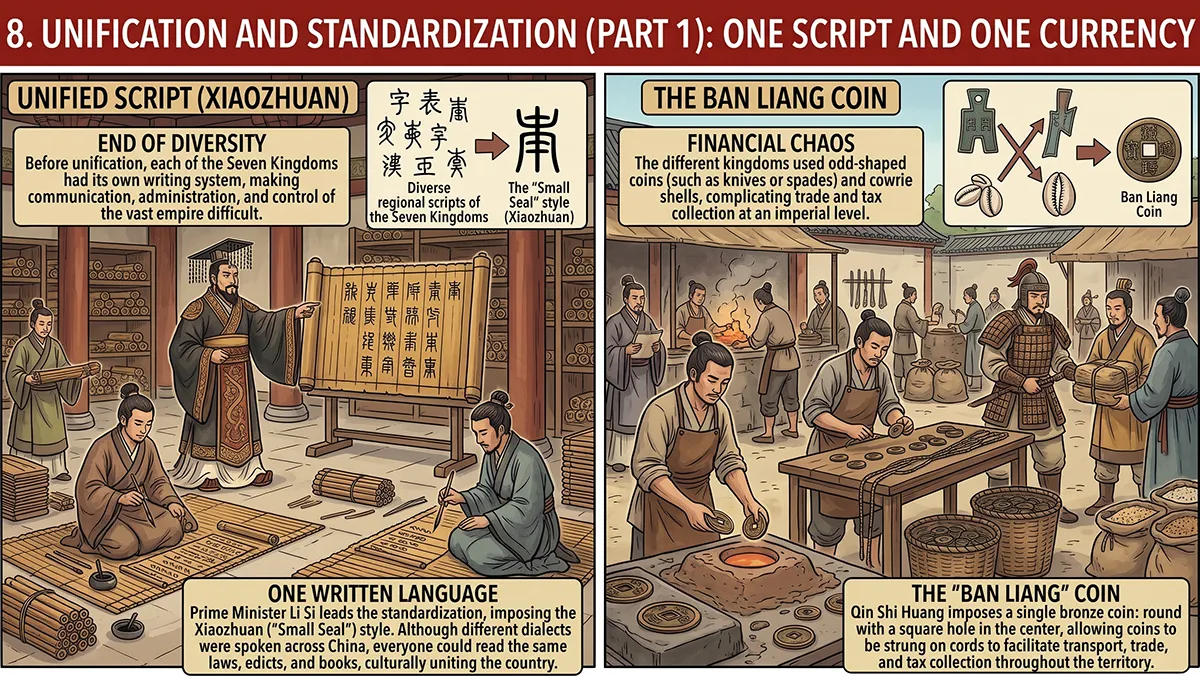
Unified Writing (Xiaozhuan, or Small Seal Script): Before unification, the very same word (such as “horse” or “sword”) was drawn in seven different ways depending on the region. Li Si oversaw the creation of a single, clear, and harmonious writing system called Xiaozhuan, eliminating hundreds of local variants.
-
The Secret of Cultural Unity: This step proved decisive for the entire subsequent history of East Asia. Even though people in northern and southern China spoke dialects so different that they could not understand one another in conversation, everyone could read the exact same edicts, books, and letters, because Chinese characters represented ideas rather than spoken sounds. Imperial scribes later simplified this style further into clerical script (Lishu), the direct ancestor of modern Chinese characters.
-
-
The Ban Liang Coin (The Birth of Classic Chinese Money): Across the Warring States, coins circulated in bizarre shapes: knife-shaped coins in Qi, agricultural spade-shaped coins in Wei and Zhao, cowrie shells in Chu, and bronze discs in Qin. Qin Shi Huang banned them all and established a single official currency for the entire empire: the Ban Liang coin.
-
Symbolic and Practical Design: It was a round bronze coin with a square hole in the center. To the ancient Chinese, the circle symbolized Heaven and the square represented Earth. Beyond its cosmic symbolism, the square hole allowed hundreds of coins to be strung together on cords (known as guan), making it easy to carry large sums for trade and tax collection. This design proved so practical that it remained in continuous use in China for more than 2,100 years (until the early 20th century).
-
Part Two: Weights, Measures, and the Width of Cart Axles
Standardization did not stop at paper or coins; it reached the humblest markets and most distant roads of the empire:
-
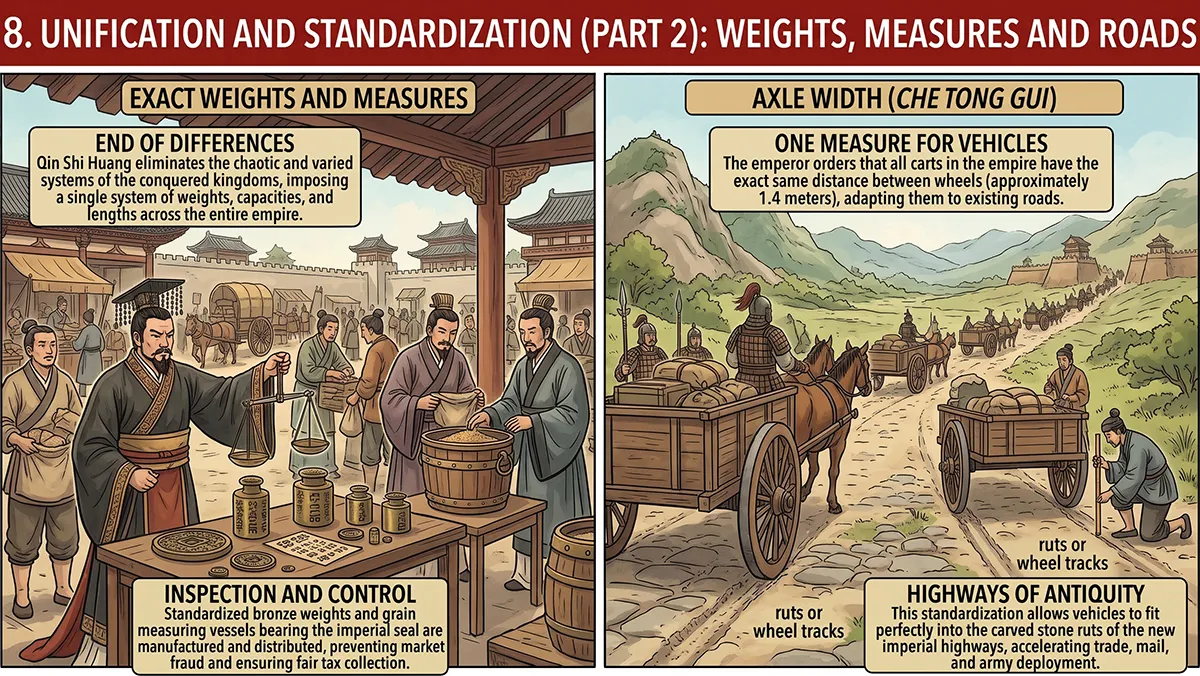
Exact Weights and Measures to End Fraud: Before unification, a “bushel” of grain or a “yard” of cloth measured differently in every province, leading to constant cheating in marketplaces and chaos when collecting grain taxes. The imperial government manufactured official bronze weights and standard measuring vessels engraved with the emperor’s own decree mandating strict compliance. Inspectors regularly toured cities to check merchants’ scales; anyone caught altering a measure faced severe punishment.
-
Road Engineering (Che Tong Gui — “Carts with the Same Axle Width”): In antiquity, dirt and stone highways quickly developed deep ruts carved by the constant passage of cart wheels. Because each kingdom had built carts with different axle widths, a merchant traveling from one region to another would get stuck trying to fit his wheels into the neighboring kingdom’s ruts, forcing him to switch vehicles or unload all his cargo at the border.
-
The Imperial Solution: Qin Shi Huang decreed that every cart and carriage in the empire had to be built with the exact same distance between wheels (roughly 1.4 meters, or 4.6 feet). Thanks to this deceptively simple rule, any imperial, merchant, or military wagon could roll at full speed from the capital Xianyang to the farthest frontiers without ever stopping.
-
Thanks to these four reforms—a unified writing system, a single currency, standardized weights and measures, and a common network of roads—China forged a shared identity so robust that, even when dynasties fell or political divisions arose centuries later, the country always managed to reunify.
9. The Dark Side of the Empire: Extreme Legalism and Thought Control
The unification of China and its colossal public works came at an immense human and cultural cost. To subdue millions of former enemies in record time, Qin Shi Huang rejected Confucian compassion and Daoist non-interference, adopting as the official state ideology the harshest doctrine of the Axial Age: Legalism (Fajia). Under this regime, the individual did not exist to pursue happiness, but to obey, farm, and fight in service of the emperor.
Part One: The Legalist Machine and the Surveillance Society
-
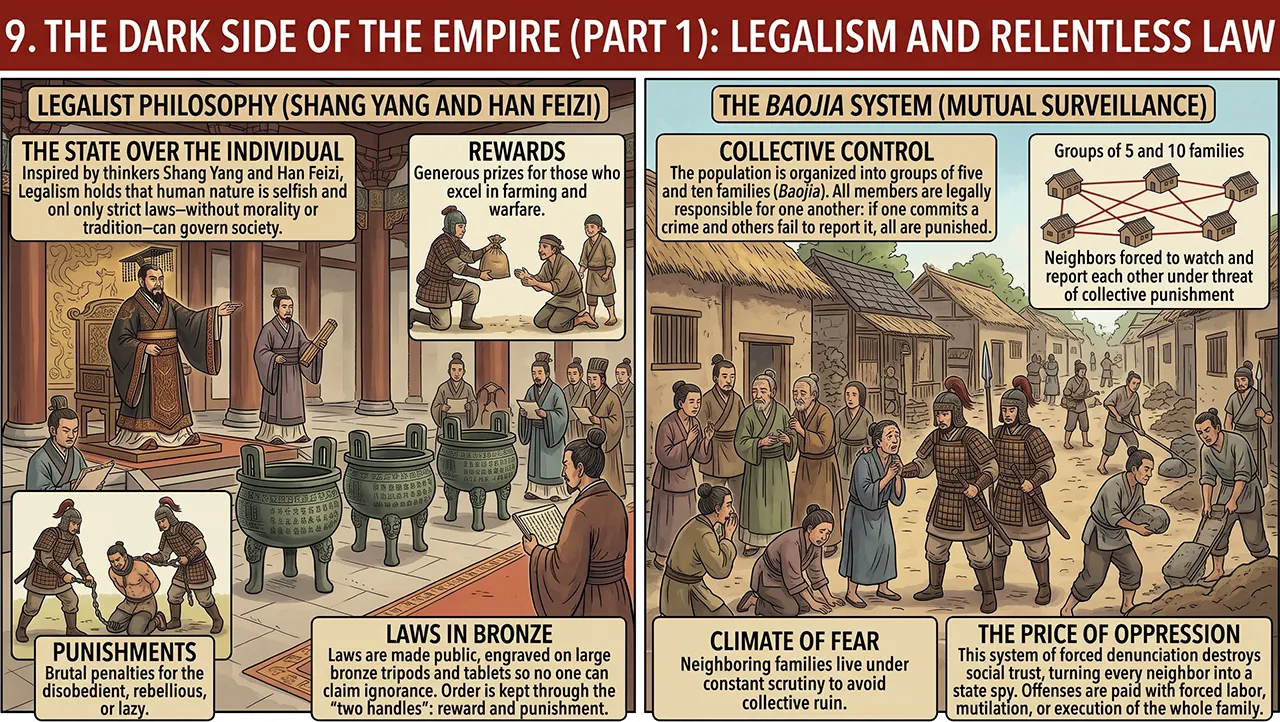
The “Two Handles” of Power (Shang Yang and Han Feizi): Legalism rested on a pessimistic view of human nature, arguing that people are inherently selfish and respond only to fear and self-interest. According to the philosopher Han Feizi, a ruler had to grip the State using two unfailing tools:
-
Generous Rewards: Promotions, land grants, and tax exemptions for those who produced abundant grain harvests or severed enemy heads in battle.
-
Relentless Punishments: Disproportionate fines, physical mutilation, lifelong forced labor, or execution even for minor infractions (such as arriving late for a military muster or damaging state property). No one stood above the law—not even nobles.
-
-
The Baojia System (Mutual Surveillance and Collective Punishment): To crush any conspiracy before it could take root, the government organized the entire population into groups of five and ten families (Baojia). All members of a group were held legally responsible for one another: if one neighbor committed a crime and the others failed to report it immediately to the authorities, every family in the group suffered the exact same punishment. In this way, every citizen became a spy watching their own neighbor.
-
An Empire of Forced Labor: Hundreds of thousands of peasants, prisoners of war, and convicts sentenced for minor offenses were uprooted from their villages and marched off to build highways, palaces, canals, walls, and imperial tombs under brutal conditions, fueling deep popular resentment.
Part Two: The Burning of Books and the Persecution of Scholars
The collision between Legalist authoritarianism and traditional thinkers erupted in 213 BC. During an imperial banquet, a Confucian scholar publicly criticized the abolition of the old feudal system and praised the customs of the Zhou Dynasty. To Qin Shi Huang and his prime minister Li Si, looking back to the past was an act of political rebellion against the present.
-
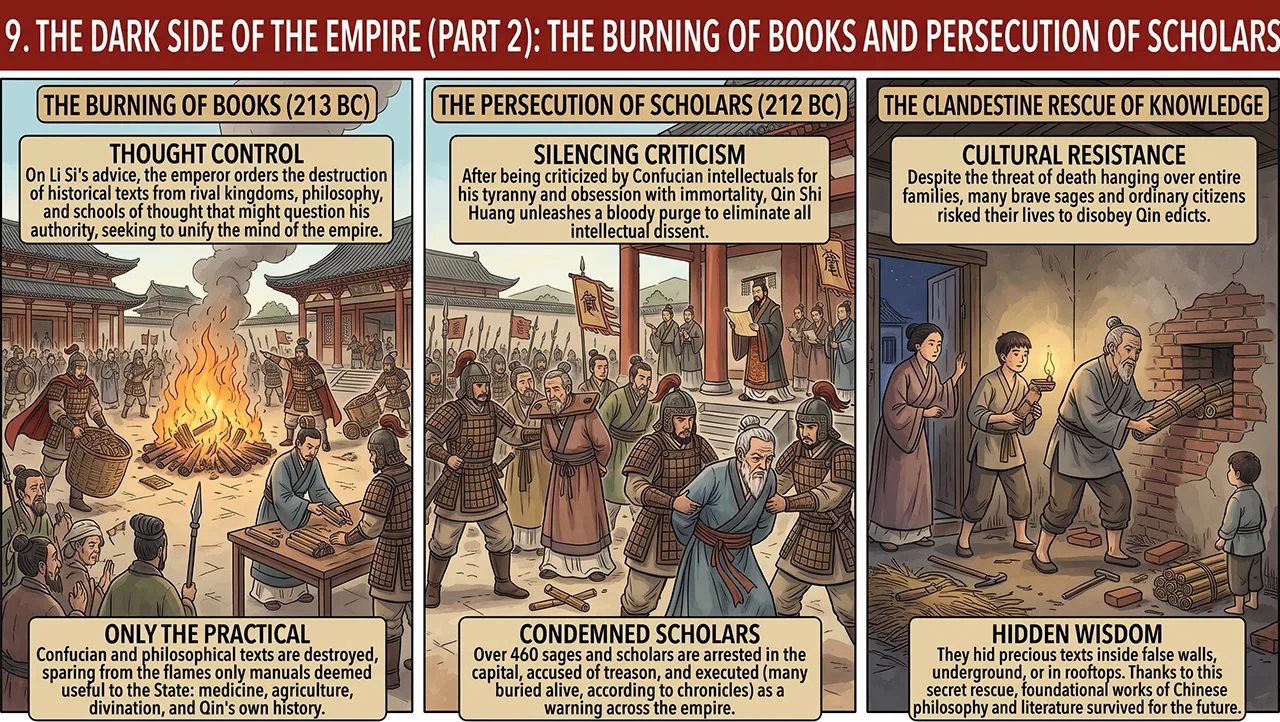
The Great Burning of Books (213 BC): Li Si proposed erasing the historical memory of the former kingdoms so that no one could use the past to criticize the emperor. Imperial edicts ordered the confiscation and burning across China of the historical chronicles of all conquered states as well as all philosophical treatises (especially the works of Confucius and the Hundred Schools).
-
Which Books Were Spared? Private citizens were permitted to keep only strictly practical manuals on agriculture, medicine, pharmacy, and divination, while a single master copy of the banned works was locked inside the Imperial Library in Xianyang.
-
-
The Persecution of Scholars (212 BC): One year later, infuriated that several scholars and alchemists had criticized his tyranny and his obsession with immortality, the emperor ordered a ruthless purge in the capital: according to the records of historian Sima Qian, roughly 460 sages were sentenced to death (tradition recounts they were buried alive) as a stark warning to silence any dissenting voice.
-
The Clandestine Rescue of Knowledge: Despite the terror, many scholars risked their lives to save China’s cultural heritage. They concealed bamboo scrolls inside the hollow brick walls of their homes, beneath floorboards, or inside ancient tombs. Decades later, after the fall of the Qin Dynasty, these hidden texts were recovered—including a copy of The Analects discovered inside a wall of Confucius’s ancestral home—allowing the wisdom of the Axial Age to survive to the present day.
This ninth section highlights the contrast between the brilliant organizational efficiency of the Qin Empire and the high cost of its authoritarianism—a factor that would ultimately lead to its rapid collapse just four years after the death of Qin Shi Huang.
10. The Great Wall (Changcheng): The Gigantic Shield of Stone and Earth
One of the greatest threats facing the newly unified Chinese empire came not from within, but from the vast northern steppes. From there, confederations of nomadic peoples—chiefly the Xiongnu—launched swift, relentless raids to plunder the crops and cities of the agricultural plains.
To put a permanent end to this threat, Qin Shi Huang ordered one of the greatest military engineering feats of all time: the Great Wall (Wanli Changcheng, or “The Wall of Ten Thousand Li”).
Part One: Connecting the Past to Shield the Future
-
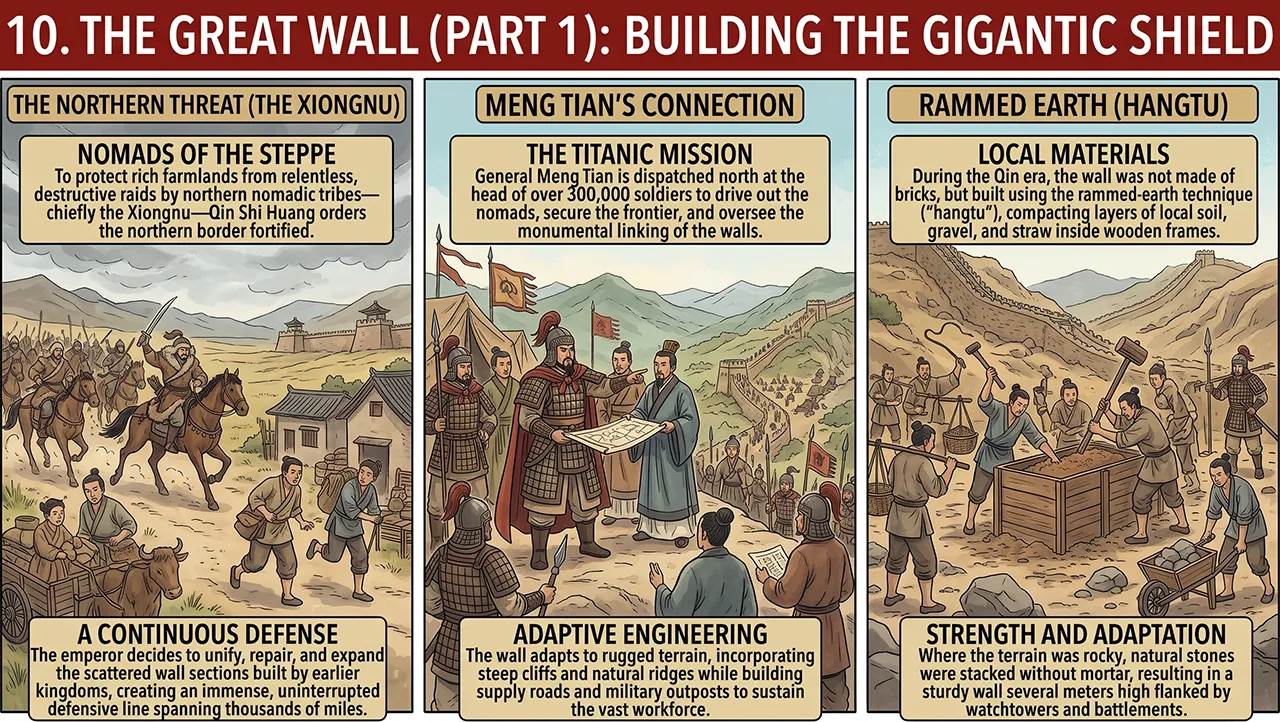
A Network of Pre-Existing Walls: Contrary to popular belief, Qin Shi Huang did not build the Great Wall from scratch. During the Warring States period, northern states (such as Zhao, Yan, and Qin itself) had already constructed earthen wall sections to defend themselves both from steppe nomads and from rival kingdoms.
-
Meng Tian’s Great Connection (215 BC): The emperor entrusted this titanic mission to his most brilliant and loyal general, Meng Tian, commanding an army of more than 300,000 soldiers. Meng Tian not only drove the Xiongnu beyond the Yellow River, but also undertook the task of linking, repairing, and expanding existing defensive walls, while tearing down internal walls that had previously divided the former kingdoms. The result was an immense continuous defensive line stretching thousands of miles across mountain ridges, deserts, and gorges, from Gansu in the west to Liaodong in the east.
-
The Use of Local Materials: During the Qin Dynasty, the wall was not built with the fired bricks and dressed stone blocks visible today (which largely date from the Ming Dynasty reconstruction many centuries later). Instead, builders used the rammed-earth technique (hangtu), compacting layers of local soil, gravel, and straw with heavy wooden mallets inside timber frames. In mountainous areas, natural stones were stacked without mortar, adapting the wall to rugged terrain and incorporating steep cliffs and natural ridges as part of the barrier.
Part Two: The Immense Human Drama and the Legend of Meng Jiangnü
Constructing such a colossus in a record time of barely a decade required an unprecedented forced mobilization of labor in the ancient world.
-
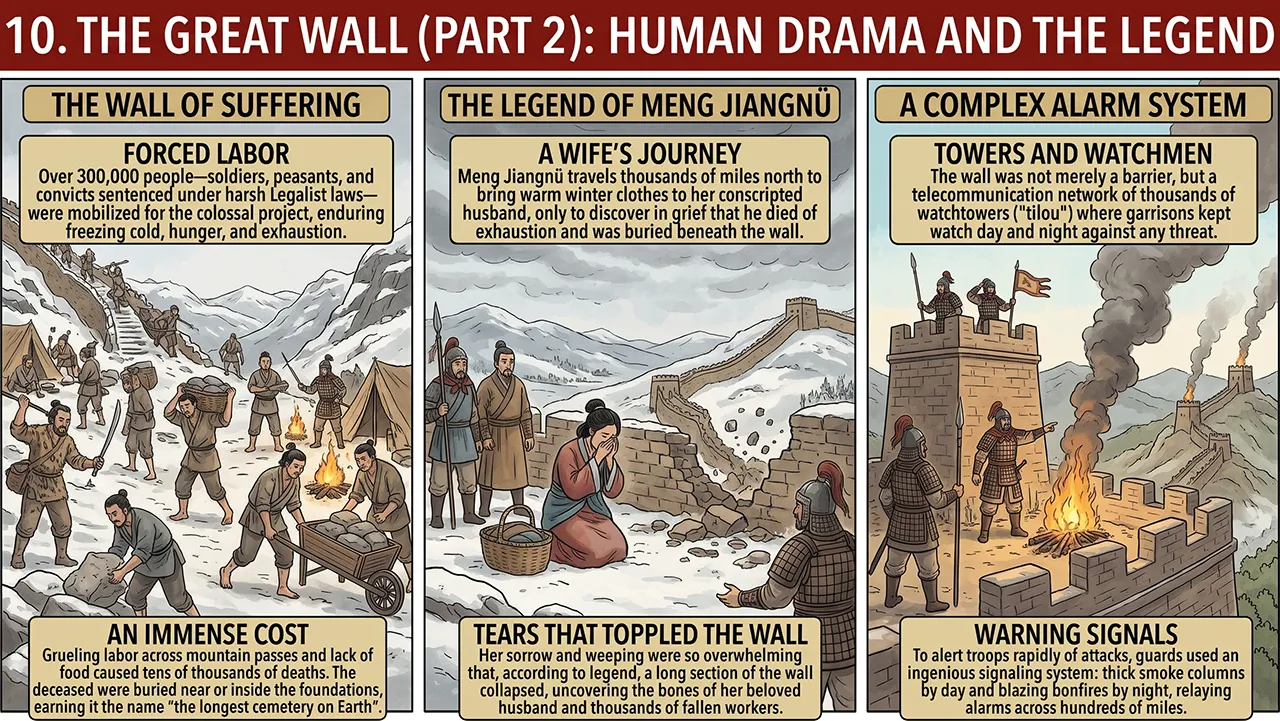
The Wall of Suffering: General Meng Tian deployed hundreds of thousands of laborers. An estimated 300,000 to 500,000 workers toiled under extreme conditions—comprising soldiers, peasants fulfilling mandatory labor service (corvée), and above all a vast mass of convicts sentenced to hard labor under harsh Legalist laws.
-
An Unforgiving Environment: Workers hauled heavy loads on foot using wheelbarrows, baskets, pulleys, and pack animals up steep slopes and perilous mountain passes. They endured freezing northern winters and scorching summers with meager rations and no medical care. Tens of thousands died from accidents, exhaustion, starvation, and disease. Their bodies were buried in mass graves near or within the foundations, leading ordinary people to call the Great Wall “the longest cemetery on Earth.”
-
The Legend of Meng Jiangnü: The people’s grief was immortalized in one of China’s most famous legends. It tells of a young woman whose husband was conscripted to work on the wall just days after their wedding. Hearing no word from him, Meng Jiangnü embarked on a long, perilous journey north on foot to bring him warm winter clothing. Upon arriving, she discovered that he had already died of exhaustion and been buried beneath the wall’s foundations. Her weeping was so heart-wrenching that, according to legend, a long stretch of the wall collapsed, uncovering the bones of her beloved husband and thousands of other fallen workers.
-
A High-Speed Alarm System: More than a simple barrier, the wall functioned as a sophisticated defense and telecommunication network. It featured thousands of watchtowers (tilou) and battlements where soldiers stood guard. Whenever an enemy attack was spotted, garrisons used an ingenious signaling system to relay the alarm across hundreds of miles within hours: thick smoke columns by day and blazing bonfires by night, allowing reinforcements to rush in from nearby military camps.
11. The Terracotta Army: The First Emperor’s Immortal Guardians
Qin Shi Huang did not merely wish to rule China in life; his greatest obsession was to continue reigning in the afterlife with the same power, luxury, and military protection he had enjoyed on Earth. To achieve this, as soon as he ascended the throne at age 13, he ordered the construction of a colossal subterranean city beside Mount Li (near modern-day Xi’an), guarded by what is today regarded as the Eighth Wonder of the World: the Terracotta Army.
Part One: An Underground Empire Hidden for Two Millennia
-
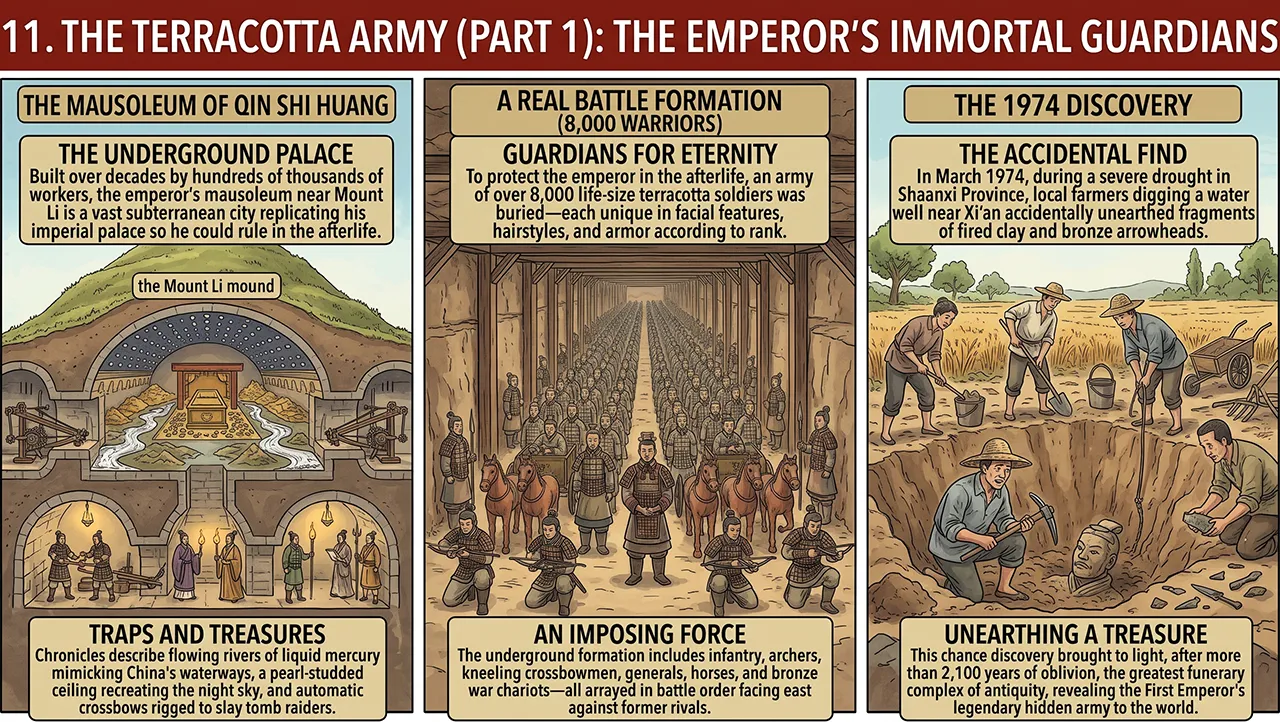
The Secret Mausoleum of the First Emperor: Qin Shi Huang’s necropolis spans a colossal area of more than 56 square kilometers (over 21 square miles)—nearly the size of Manhattan. At its center rises a pyramid-shaped earthen mound over 76 meters (250 feet) tall that remains unexcavated today to preserve its interior. According to ancient historian Sima Qian, deep beneath that artificial mountain lay an exact replica of the empire:
-
Rivers of Liquid Mercury: The floor of the burial chamber contains relief maps where the Yangtze and Yellow rivers flow with mechanically circulated liquid mercury, while the ceiling is inlaid with pearls and gemstones reproducing the constellations of the night sky.
-
Deadly Traps: To protect his resting place from tomb raiders, craftsmen installed automatic crossbows rigged to tripwires that fired arrows the moment anyone forced the doors open. Tradition holds that once the tomb was sealed, the very artisans who knew its secrets were locked inside forever.
-
-
A Real Battle Formation Ready to Fight: About a mile east of the main mound, buried in four large subterranean pits reinforced with timber beams and brick floors, stand more than 8,000 life-size fired-clay (terracotta) warriors (between 1.80 and 1.95 meters tall), alongside 130 war chariots drawn by 520 horses and 150 cavalry horses. Far from being arranged at random, they are deployed in an authentic tactical battle formation facing east—toward the former rival kingdoms Qin had conquered—complete with a vanguard of crossbowmen, main infantry columns, protected flanks, and a command post led by high-ranking generals.
-
The Chance Discovery of 1974: For more than 2,100 years, no one knew this army existed beneath the farm fields. In March 1974, during a severe drought, local farmers digging a well in search of water struck a fired-clay head and several bronze arrowheads with their hoes. That accidental find revealed Asia’s greatest archaeological treasure to the world.
Part Two: Assembly-Line Engineering, Unique Faces, and Real Weapons
What amazes modern historians and archaeologists most about the Terracotta Army is how it blends industrial mass production with unmatched individual artistic realism:
-
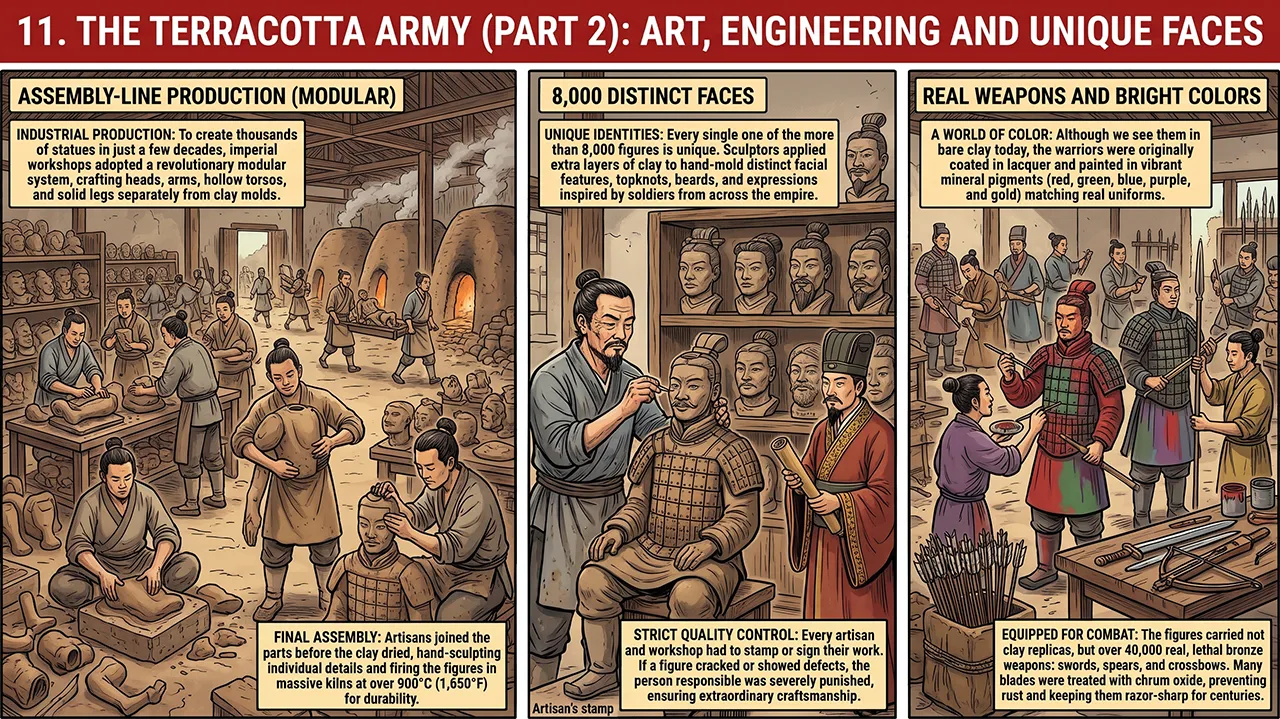
Modular Workshop Production: To produce thousands of figures within a few decades, over 700,000 workers and master potters organized an assembly-line system of separate components. Legs were sculpted solid for stability, while torsos and arms were coiled hollow from clay strips so they would not crack or explode when fired in massive kilns. Heads, hands, and ears were crafted separately, joined with wet clay, and hand-carved with fine details.
-
Millennia-Old Quality Control: Every master artisan had to stamp or sign their name on the pieces they made; if a statue cracked or showed defects, the person responsible could be immediately identified and punished.
-
-
8,000 Distinct Faces (Portrait of an Empire): Although bodies followed standardized molds according to military rank (light infantryman, kneeling archer, charioteer, officer, or general), no two faces are alike. Sculptors modeled real soldiers drawn from every corner of the empire: beardless youths, wrinkled veterans, varied mustaches and beards, distinct nose and cheekbone shapes, and intricate topknots and headdresses indicating military rank.
-
From Bright Colors to Earth Tones: Today we see them in bare gray-brown clay, yet originally every warrior was painted in vivid, glossy colors (vermilion red, malachite green, blue, purple, and gold) made from natural lacquer and mineral pigments. Upon exposure to air in 1974, the lacquer dried and flaked off within minutes, prompting modern archaeologists to develop instant chemical preservation techniques.
-
Authentic Weapons and Anti-Rust Technology: The warriors held not clay props, but more than 40,000 real bronze weapons (long swords, spears, halberds, and crossbows). Many sword blades emerged as sharp as the day they were forged thanks to an advanced metallurgical breakthrough: craftsmen coated the blades with a microscopic layer of chromium oxide, an anti-corrosion treatment not patented in Europe or America until the 20th century.
12. Advances and the Silk Road: China’s Technical Genius and Its Encounter with the World
The legacy of the Axial Age and imperial unification extended far beyond laws, walls, and philosophy. During the late Zhou Dynasty, the brief yet intense Qin reign, and the subsequent splendor of the Han Dynasty (which inherited Qin’s unified state while softening its harsh laws with Confucianism), China became the most technologically advanced civilization on Earth. Its inventions transformed agriculture, navigation, and global culture, while its most prized treasure—silk—opened for the first time a network of trade routes linking East Asia with the Roman Empire.
Part One: Great Inventions and Engineering That Changed History
Many breakthroughs unknown in Europe until the Middle Ages or the Renaissance were already operating at full scale in ancient China:
-
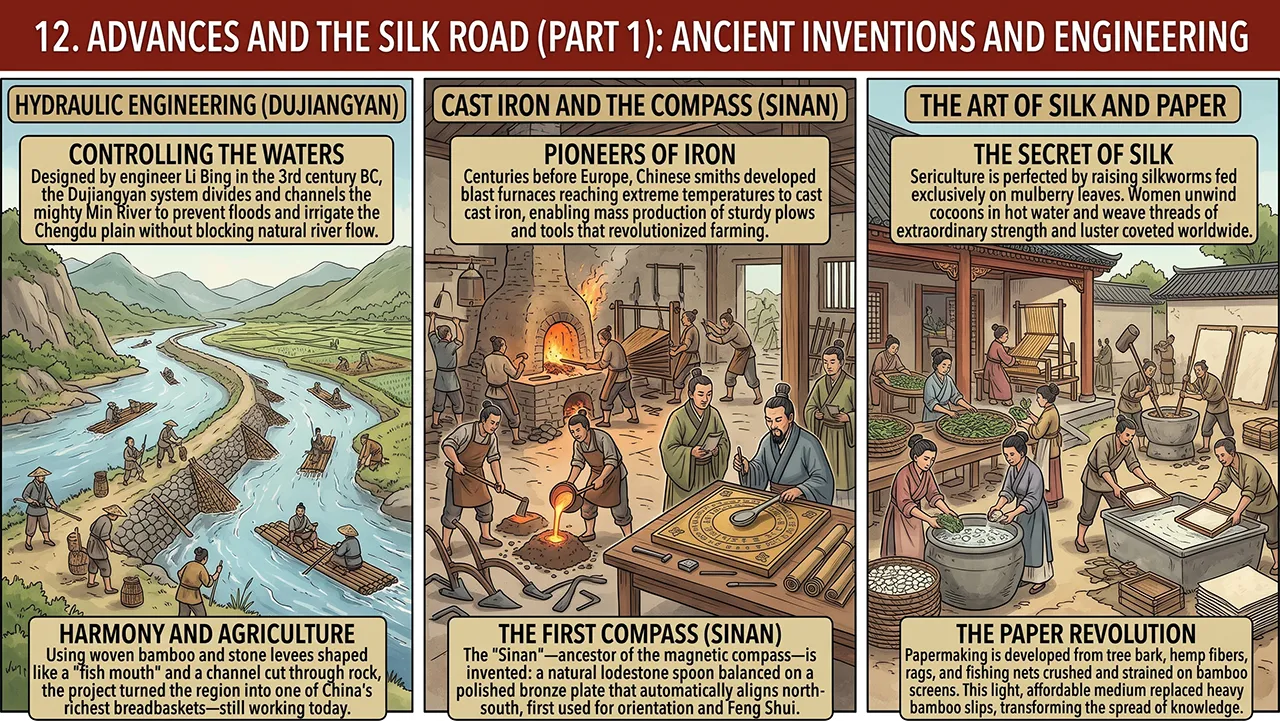
The Dujiangyan Irrigation System (256 BC): Built by engineer Li Bing in Sichuan shortly before Qin unification, it stands among the greatest hydraulic engineering feats in history. Rather than building a solid dam across the Min River that floods would eventually destroy, he designed a fish-mouth dividing levee and a rock-cut channel that diverted the exact amount of water needed into farm fields while allowing silt to wash downstream. It eliminated catastrophic floods, turned the region into the empire’s breadbasket, and still operates today, more than 2,250 years later.
-
Agricultural Revolution and Cast Iron: Using blast furnaces capable of reaching extraordinarily high temperatures, Chinese ironworkers mastered cast iron more than a thousand years before the West. They mass-produced iron plowshares, hoes, and multi-tube seed drills that multiplied harvests of irrigated rice in the south and millet in the north, feeding a population of tens of millions.
-
The First Compass (Sinan): During the Warring States and Qin periods, scholars discovered the magnetic properties of lodestone. They created the Sinan (“south-pointer”), a spoon carved from natural magnetite balanced on a polished bronze plate engraved with cardinal directions; its handle always pointed south. It was first used to align buildings and tombs in harmony with the environment (Feng Shui) before revolutionizing maritime navigation.
-
The Secret of Silk and the Birth of Paper:
-
Sericulture: For millennia, Chinese women mastered the art of raising silkworms fed on mulberry leaves, unwinding delicate filaments from their cocoons, and weaving light, durable, shimmering fabrics whose production secret was guarded under penalty of death for centuries.
-
Paper: To replace heavy bamboo slips and costly silk scrolls used by scribes, paper was invented around the 2nd century BC (and perfected by Cai Lun in 105 AD) from tree bark, hemp fibers, old rags, and fishing nets pulped and pressed on screens.
-
Part Two: The Silk Road — The Bridge Between East and West
For centuries, the towering Pamir Mountains, the Tibetan Plateau, and unforgiving deserts isolated China from Mediterranean civilizations. Everything changed shortly after the Qin Dynasty under Emperor Wu of the Han Dynasty:
-
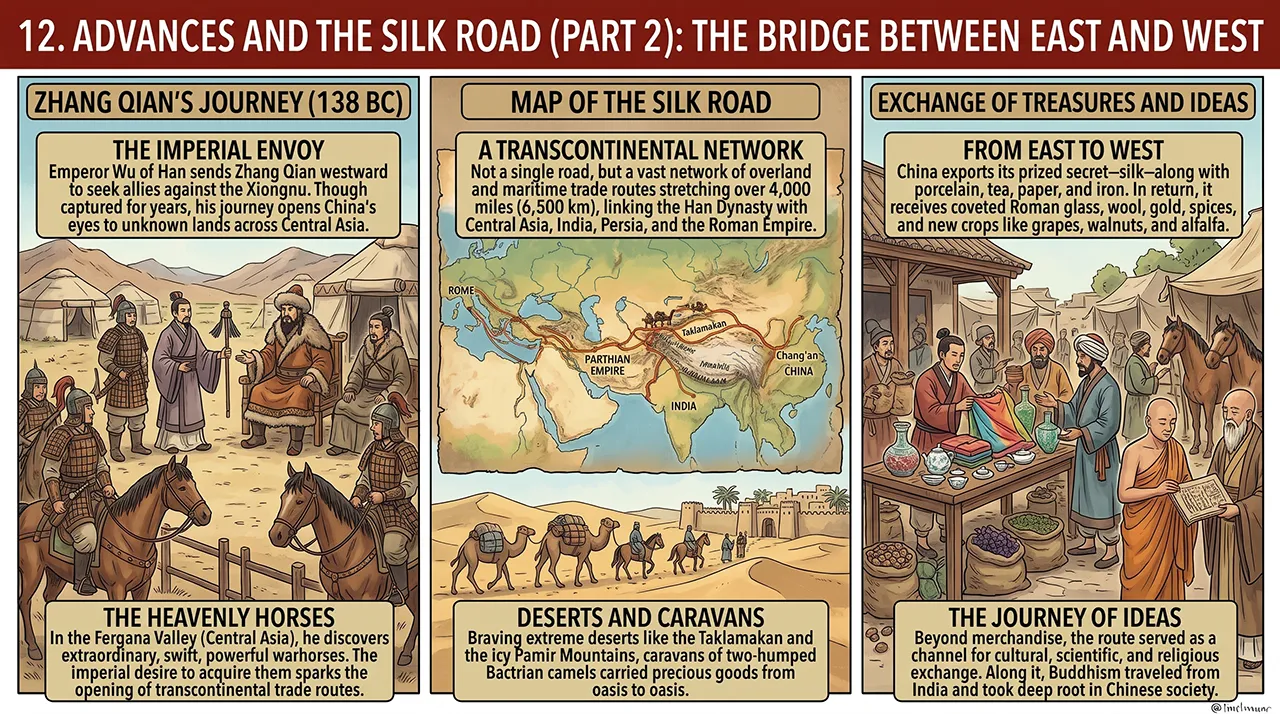
The Epic Journey of Zhang Qian (138 – 125 BC): Seeking allies against the northern Xiongnu nomads, Emperor Wu dispatched explorer Zhang Qian westward with a hundred men. Captured by nomads for ten years, he escaped and reached Central Asia (modern-day Uzbekistan and Afghanistan). He returned thirteen years later with only one surviving companion, bringing detailed reports of unknown kingdoms (such as Persia, India, and word of the distant Greco-Roman world) and describing the legendary “heavenly horses” of the Fergana Valley—far larger and swifter than Chinese horses. His expeditions officially opened the gateway to the West.
-
A Caravan Network Spanning Over 4,000 Miles (6,500 km): The Silk Road was not a single highway, but a vast network of trails starting at the imperial capital Chang’an (near ancient Xianyang/Xi’an), skirting the treacherous Taklamakan Desert from oasis city to oasis city (such as Dunhuang and Kashgar), crossing the icy Pamir Mountains, traversing Persia, and reaching eastern Mediterranean ports where ships carried goods onward to Rome. Few merchants ever traveled the entire route; instead, goods passed from hand to hand via relays of two-humped Bactrian camel caravans.
-
An Exchange of Goods, Flavors, and Ideas:
-
From East to West: Rolls of silk (which in Ancient Rome were literally worth their weight in gold and captivated Roman senators and patricians), lacquerware, bronze, spices, tea, porcelain, and technologies such as papermaking traveled westward.
-
From West to East: Fergana horses, Roman glassware, Persian carpets, gold, silver, and new crops that transformed Chinese cuisine forever—grapes, walnuts, pomegranates, sesame, alfalfa, and cucumbers—traveled eastward.
-
The Journey of Ideas: Along these very same routes traveled not only merchandise, but also religions, scientific knowledge, and art; thus Buddhism arrived in China from India, blending with Daoism and Confucianism to enrich Asian civilization further.
-
Appendix: Comparative Chronology — Imperial China vs. Egypt, Greece, and Rome
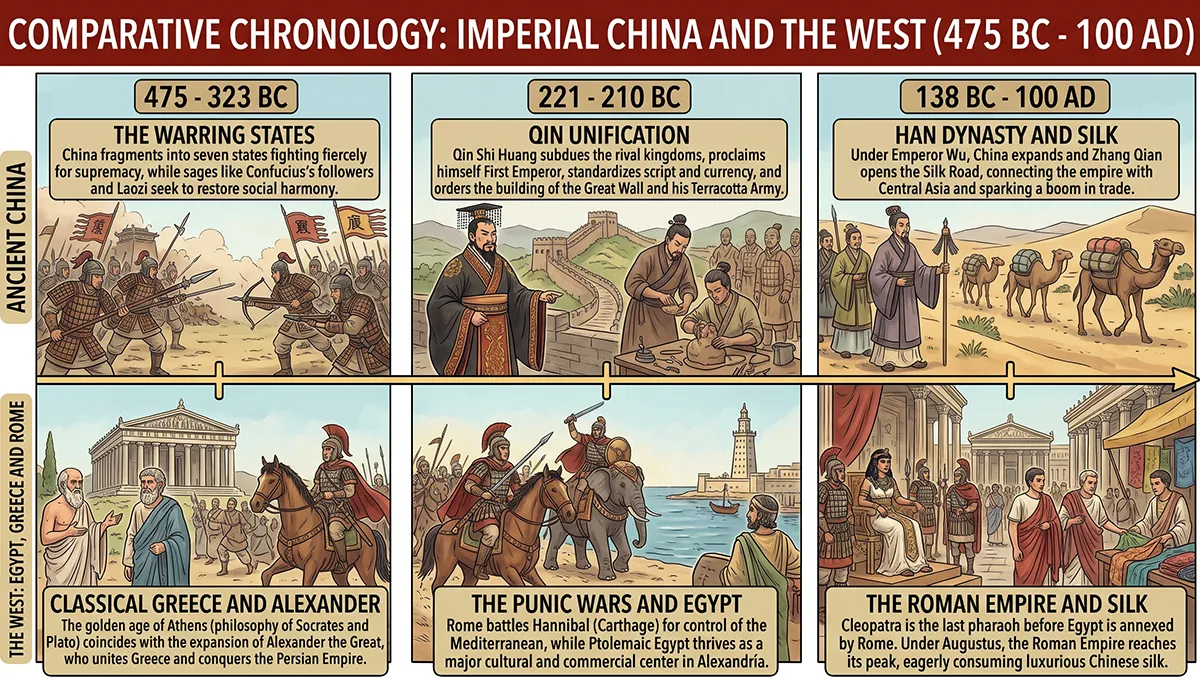
To grasp the true scale of human history, nothing is more illuminating than seeing what was happening simultaneously at both ends of the Eurasian landmass. While pharaohs rose in the Mediterranean, Athenian democracy was born, and Rome expanded across Europe, an equally sophisticated civilization was taking shape in East Asia.
Stage One: From Feudal Origins to the Awakening of the Sages (1050 – 475 BC)
Stage Two: From Great Empires to Meeting Along the Silk Road (475 BC – 1st Century AD)
Comparative Chronology: Imperial China vs. The West
Explore what was happening simultaneously in China and across the Mediterranean (Egypt, Greece, and Rome). Click any card to read the full historical profile.
We hope you have enjoyed the content about this ancient Asian civilization, as well as the collection of illustrations and explanatory drawings. Now, if you would like to continue the adventure and explore other periods in the fascinating history of humanity, we invite you to check out these chapters.