


Before a character takes its first step, it must be defined. Character Design is the art of creation, but the Model Sheet is the science of consistency. Dive into the world of blueprints, turnarounds, and expression guides—the essential tools that allow animators across the globe to speak the same visual language and bring a single vision to life.
The Blueprint of Life: What is a Model Sheet?
In the world of professional animation, a character isn’t just a drawing; it’s a living asset that must look the same from every angle and in every emotional state. A Model Sheet (also known as a Character Study or Model Pack) is a technical document that defines a character’s appearance, structure, and gestures.
Its primary purpose? Consistency. Whether a character is being animated by a studio in California or an outsourcing house in Spain, the Model Sheet ensures that the protagonist’s proportions and “soul” remain identical in every single frame.
Model Sheet Study Notes: Female Character Turnaround
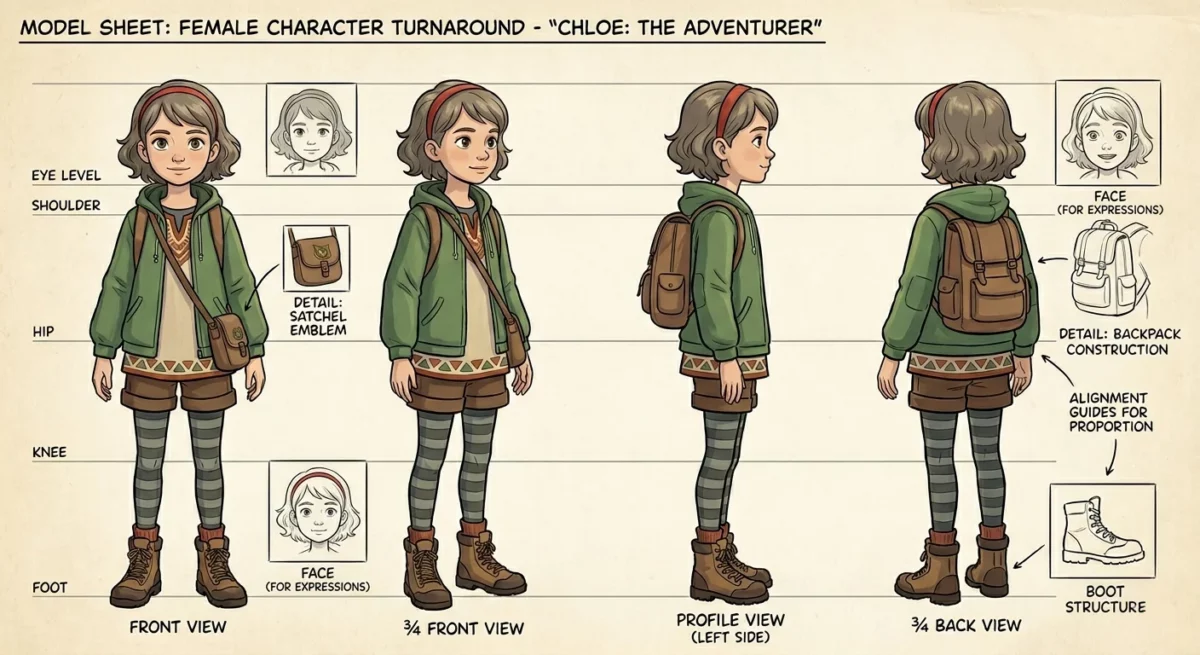
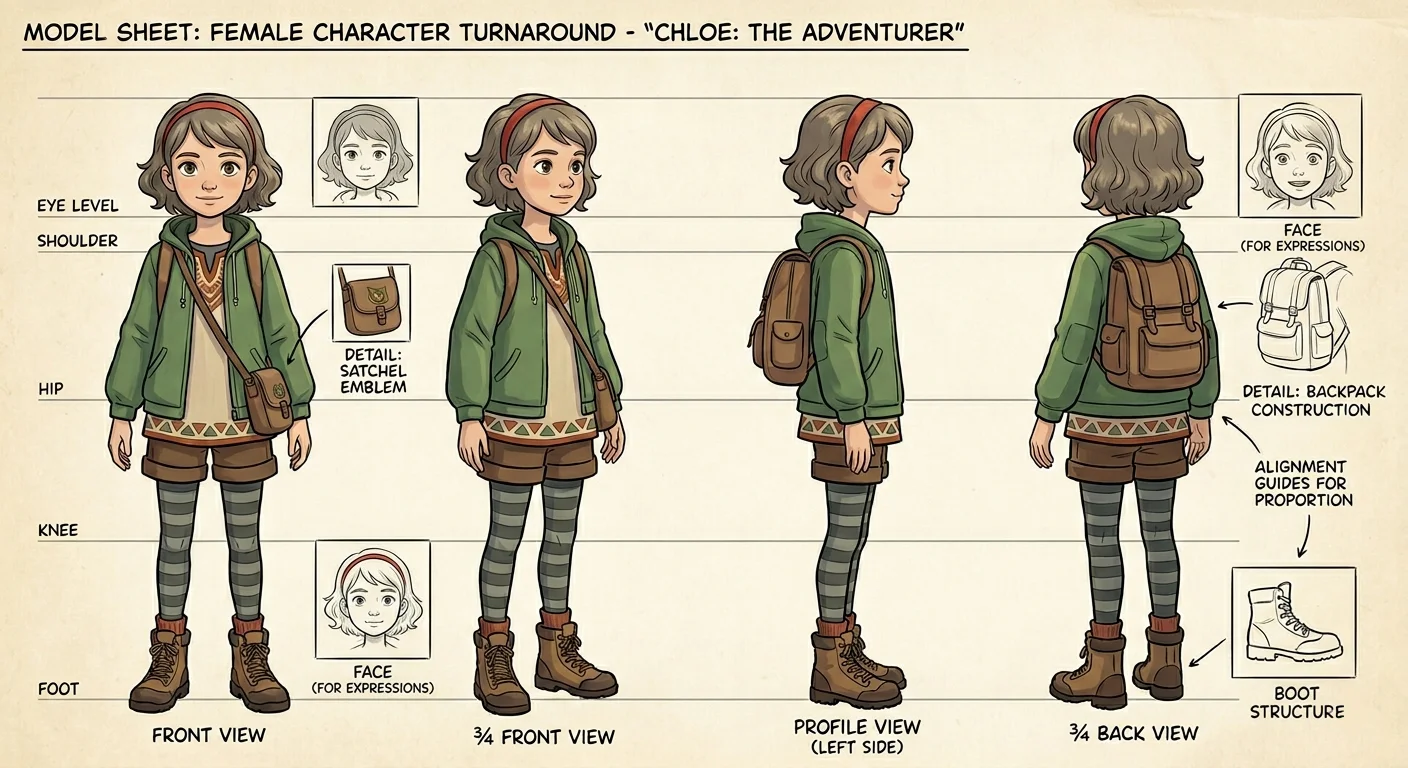
This image is a comprehensive example of a professional character model sheet. Here are the key technical elements that make it effective for animation production:
-
Multiple Views (Turnaround): This sheet includes the four fundamental views: Front, ¾ Front, Profile, and ¾ Back. These aligned views are essential for animators (and 3D modelers) to understand the character’s full 360-degree volume in three-dimensional space.
-
Technical Alignment Guidelines: Notice the horizontal guide lines marked on the left (Eye Level, Shoulder, Hip, Knee, Foot). They function as a ruler to ensure that anatomy, facial features, and clothing details remain at the exact same height across all views. This is crucial for maintaining consistency, or staying “on-model,” throughout the animation process.
-
Animation-Friendly Character Design: The character, “Chloe,” is designed with a very appealing but simplified style that is economical to animate. Her adventurer gear (jacket, shorts, boots) utilizes clear, distinct shapes and avoids overly complex details that would overload the production team when drawing hundreds of frames.
-
Professional Annotations & Details: Technical labels and handwritten notes provide crucial specific information. For example, pointing out the emblem on her satchel or the construction of her backpack from behind. The studio-paper texture in the background gives the sheet the feel of a real, real-world working production document.
Anatomy of a Professional Model Pack
A complete character study is rarely just one page. It is usually a collection of several specific types of sheets:
-
The Turnaround: The most iconic sheet. It shows the character in a “T-pose” or neutral stance from multiple views: Front, ¾ Front, Profile, ¾ Back, and Back.
-
Construction Guide: This reveals the “skeleton” of the character—the spheres, cylinders, and boxes used to build the anatomy. It helps animators understand the 3D volume in a 2D space.
-
Expression Sheet: A gallery of the character’s face showing different emotions (joy, anger, fear, surprise). It defines how the mouth moves and how the eyes “squash and stretch.”
-
Action/Pose Sheet: Shows the character in dynamic movements. It captures the “line of action” and how the character carries their weight when running, jumping, or sitting.
-
Size Comparison (Line-up): A sheet where all characters in the story are lined up next to each other to establish their relative heights and scales.

Model Sheet Study Notes: Male Character Turnaround – ‘Leo: The Cartographer’
This sheet provides a comprehensive technical guide for a male character, maintaining the exact same professional animation line art style, structured layout, and studio-paper background texture from Chloe’s sheet (image_14.png) to ensure production consistency. Here is a detailed breakdown of its key elements:
-
Turnaround and Aligned Poses: This turnaround includes the four fundamental full-body views: Front, ¾ Front, Profile (Left Side), and ¾ Back. Leo is in a neutral, standing pose. This structured presentation is essential for both 2D animators and 3D modelers to understand the character’s full 360-degree volume and proportions.
-
Technical Alignment Guidelines: The horizontal guide lines on the left margin (Eye Level, Shoulder, Hip, Knee, Foot) are precisely defined and scale appropriately for the slightly taller male model. They act as a strict ruler across all views to maintain consistent anatomical and feature placement, preventing the character from looking “off-model” in different angles.
-
Character Design for Leo: Leo’s design is distinct, prioritizing animation efficiency while expressing his personality. He wears a structured canvas field jacket (khaki), a rolled-up cartography shirt (light blue), a thick leather utility belt, sturdy cargo trousers, and heavy-duty explorer boots. He has goggles around his neck. This layering creates interesting depth while using clear, distinct shapes.
-
Production Annotations & Details: Professional call-outs with magnified details provide critical specific information:
-
Map Case Construction: Magnifies Leo’s specialized cartographer map case, detailing its form and how it drapes from the ¾ back view.
-
Utility Belt Pouch Emblem: Focuses on the unique compass emblem on his main belt pouch.
-
Boot Structure: Shows the specific details and lacing of his heavy-duty explorer boots.
-
-
Facial Expressions Study: Two inset boxes, “FACE (FOR EXPRESSIONS),” provide frontal and profile references for Leo’s distinct facial features and bone structure, which are crucial for lip-sync and consistent character acting across different emotions.
-
Professional Document Feel: The textured paper background and detailed technical annotations give the sheet the authentic feel of a real-world animation studio production asset.
Why is it Essential in Animation?
Without a proper model sheet, a production would fall into “off-model” chaos.
Consistency & Efficiency:
- Consistency: Ensures a uniform appearance throughout the project. It acts as a “visual law,” allowing leads to supervise large teams effectively.
- Production Efficiency: Eliminates guesswork and saves massive amounts of time. Artists no longer have to “guess” how a character looks from behind.
- Standardization: Provides a rigid framework for character development, keeping the workflow focused and predictable.
- Character Design Study: Provides detailed references that aid artists in their daily tasks, preventing creative “drift.”
- Professional Workflow: Ensures that all contributors, regardless of their role, follow the same unified artistic direction.
Performance & Expression:
- Animation Performance Guide: Orients animators on how a character should look and move in specific, diverse situations.
- Acting & Expression Library: Includes emotional poses and facial details that artists consult to maintain character integrity.
- Anatomical Integrity: Defines the skeletal structure under the hair and clothing, ensuring volume is maintained during complex motion.
- Personality Reference: Captures the gestures and behaviors that uniquely define who the character is.
Technical & Historical Value
- Technical Readiness for 3D: In modern pipelines, the turnaround is the primary blueprint for modelers to build accurate digital meshes and rigs.
- Historical Legacy: Documents the evolution of the design, providing a gallery of design changes made throughout the production cycle.
- Evolutionary Archive: Provides deep insight into how a character developed from initial concept to final polish for researchers and fans.
- Project Documentation: Serves as the “Golden Archive” for any high-quality animated production.
The Standard Model Pack
The Turnaround: Aligned views (Front, Side, Back) to define the character’s full 3D volume.
Expression Sheet: A gallery of emotions and phonemes for lip-sync and character acting.
Action Sheet: Key poses showing the character in motion, capturing weight and balance.
Character design is the art of creation, but the Model Sheet is the science of consistency.

Model Sheet Study Notes: Male Character Turnaround – ‘Grandfather: The Old Explorer’
This character study defines the aged, experienced explorer. Consistency with preceding sheets (image_14.png, image_16.png) is essential, using the same professional line art and structured technical layout on a studio-paper texture. Key technical features include:
-
Turnaround & Aligned Views: The four fundamental poses (Front, ¾ Front, Profile (Left Side), ¾ Back) are strictly aligned horizontally, ensuring full-volume consistency across a 360-degree rotation. The grandfather’s posture, slightly hunched and experienced, is captured in this structured format.
-
Technical Alignment Guidelines: The guide labels on the far left (EYE LEVEL, SHOULDER, HIP, KNEE, FOOT) are scaled precisely for an older male model. They act as a strict ruler across all views, maintaining anatomical consistency and prohibiting any features from looking “off-model.”
-
Aged Explorer Design: This designexpresses the character’s extensive past. He wears a weathered canvas field jacket, corduroy trousers, and heavily curt explorer boots. His gear—an aged map case and a robust, hand-carved walking staff—shows clear signs of extensive use.
-
Production Annotations: Specific call-outs provide magnified details of critical unique elements:
-
VINTAGE UTILITY BELT COMPASS EMBLEM: Details the antique compass pouch and belt buckle.
-
WEATHERED MAP CASE CONSTRUCTION: Shows the wear and form of the ancient map case.
-
BOOT STRUCTURE: Magnifies the scuffed and scuffed heavy-duty explorer boot.
-
-
Facial Expressions Study: Two inset boxes, “FACE (FOR EXPRESSIONS),” provide frontal and profile references of the grandfather’s specific facial features, beard, and eyewear, crucial for consistent character acting and lip-sync.
The “Design Bible”: Beyond the Drawings
A great model sheet often includes technical notes or “Rules of the Character.” For example:
-
“The ears never move above the eye line.”
-
“The tail always follows a ‘C’ curve, never an ‘S’ curve.”
-
“The character has no pupils when they are scared.”
These small details are what make a character iconic and recognizable, even if the style is minimalist.
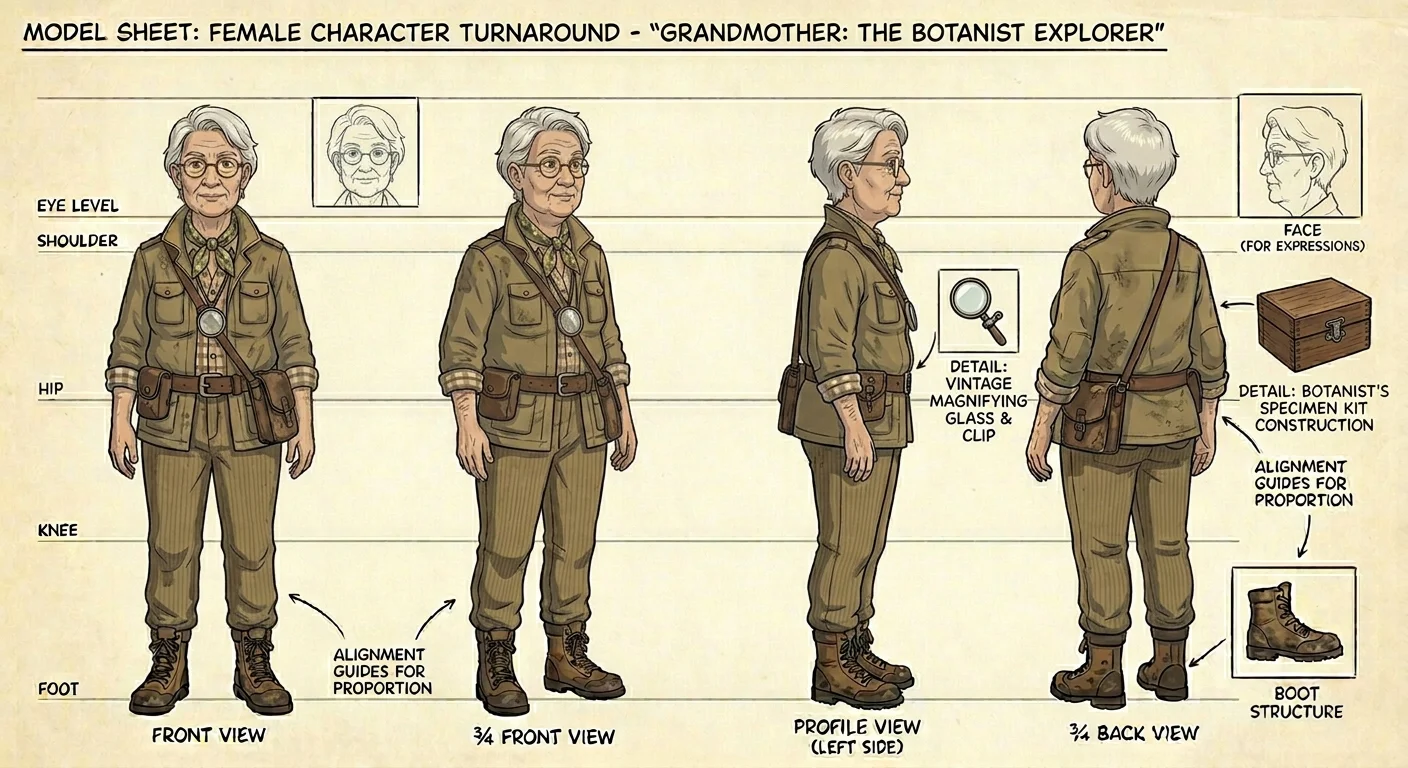
Model Sheet Study Notes: Female Character Turnaround – ‘Grandmother: The Botanist Explorer’
This character study defines the aged, active botanist. Consistency with preceding sheets (image_18.png, image_16.png, image_14.png) is essential, using the same professional line art and structured technical layout on a studio-paper texture. Key technical features include:
-
Turnaround & Aligned Views: The four fundamental poses (Front, ¾ Front, Profile (Left Side), ¾ Back) are strictly aligned horizontally, ensuring full-volume consistency across a 360-degree rotation. The grandmother’s posture, active but active, is captured in this structured format.
-
Technical Alignment Guidelines: The guide labels on the far left (EYE LEVEL, SHOULDER, HIP, KNEE, FOOT) are scaled precisely for an older female model. They act as a strict ruler across all views, maintaining anatomical consistency and prohibiting any features from looking “off-model.”
-
Botanist Design Details: This designexpresses the character’s erudyte and adventurous past. She wears a weathered field jacket, sturdy trousers, and scuffed explorer boots. Her gear—a specimen kit and a magnifying glass—shows clear signs of extensive botanical fieldwork.
-
Production Annotations: Specific call-outs provide magnified details of critical unique elements:
-
VINTAGE MAGNIFYING GLASS & CLIP: Details the antique magnifying glass and its clip.
-
DETAIL: BOTANIST’S SPECIMEN KIT CONSTRUCTION: Shows the form and wear of the specimen kit box.
-
BOOT STRUCTURE: Magnifies the scuffed heavy-duty explorer boot.
-
-
Facial Expressions Study: Two inset boxes, “FACE (FOR EXPRESSIONS),” provide frontal and profile references of the grandmother’s specific facial features, hair, and eyewear, crucial for consistent character acting and lip-sync.
Famous Examples in Animation History
-
Disney’s Golden Age: Masterpieces like Pinocchio or Bambi had incredibly detailed construction sheets that treated characters like complex 3D sculptures.
-
The Simpsons: The show famously uses strict model sheets to ensure that the yellow family stays “on-model” despite having been drawn by thousands of different artists over 30+ years.
-
Studio Ghibli: Hayao Miyazaki’s model sheets are legendary for their focus on “acting” and subtle human gestures, proving that even the most artistic films need a technical guide.
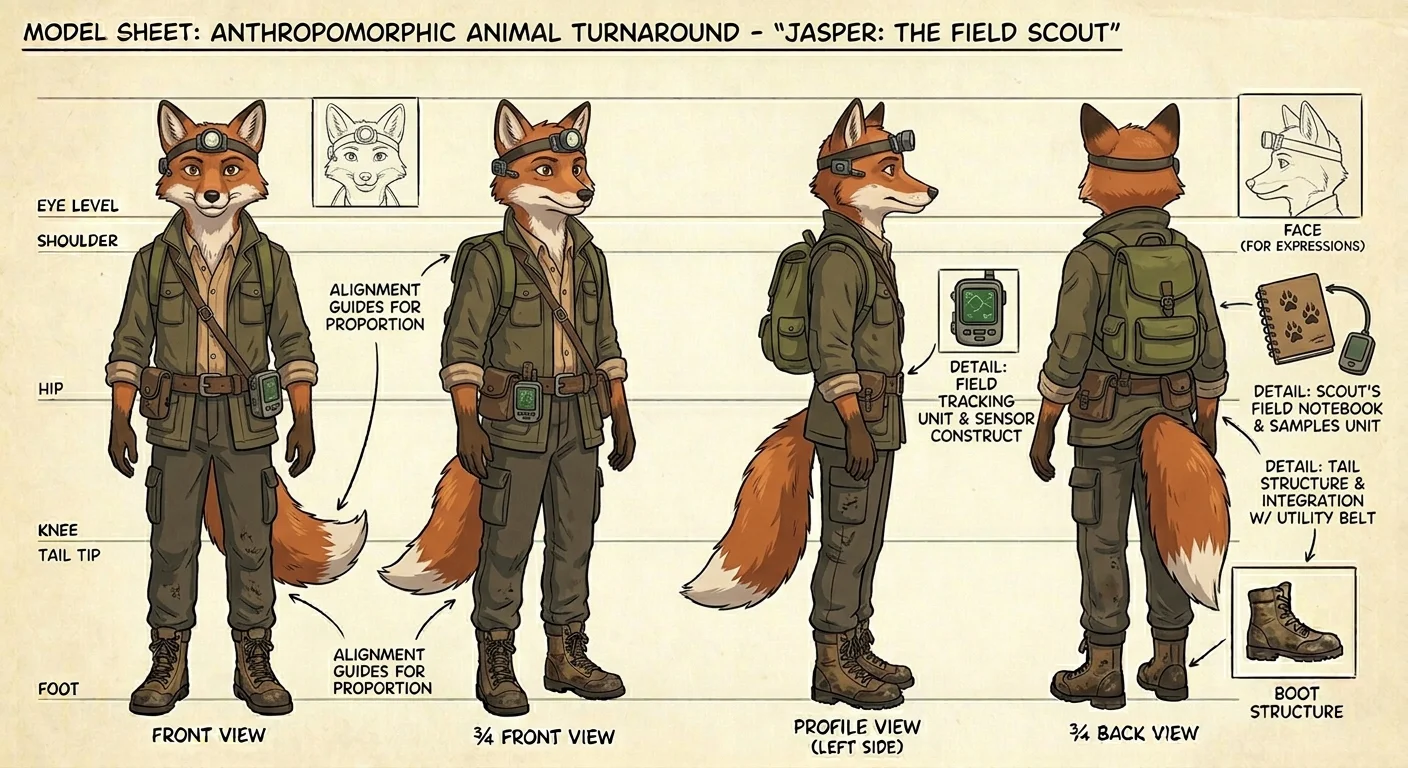
Model Sheet Study Notes: Anthropomorphic Animal Turnaround – ‘Jasper: The Field Scout’
This character study defines the alert, efficient non-human scout. Consistency with preceding sheets (image_22.png, image_20.png, image_18.png, image_16.png) is essential, using the same professional line art and structured technical layout on a studio-paper texture. Key technical features include:
-
Turnaround & Aligned Views: The four fundamental poses (Front, ¾ Front, Profile (Left Side), ¾ Back) are strictly aligned horizontally, ensuring full-volume consistency across a 360-degree rotation. Jasper’s alert and focused posture, a non-human take on the team’s explorer theme, is captured in this structured format. The inclusion of the tail must be consistent across all views.
-
Technical Alignment Guidelines: The guide labels on the far left (EYE LEVEL, SHOULDER, HIP, KNEE, FOOT, TAIL TIP) are scaled precisely for an anthropomorphic model. They act as a strict ruler across all views, maintaining anatomical consistency and prohibiting any features from looking “off-model.”
-
Scout Design Details: This design expresses the character’s specialized and efficient fieldwork. Jasper wears a compact field jacket, a utility belt, and adapted explorer boots. His gear—a field notebook, a specialized tracking unit, and an agile backpack—shows clear signs of extensive botanical fieldwork.
-
Production Annotations: Specific call-outs provide magnified details of critical unique elements:
-
DETAIL: FIELD TRACKING UNIT & SENSOR CONSTRUCT: Details the specialized tracking unit and its construction.
-
DETAIL: SCOUT’S FIELD NOTEBOOK & SAMPLES UNIT: Shows the form and details of the scout’s field notebook and its connected sample vials.
-
DETAIL: TAIL STRUCTURE & INTEGRATION W/ UTILITY BELT: Magnifies the bushy tail and how it integrates with the utility belt’s structure for functional movement.
-
BOOT STRUCTURE: Magnifies the detailed, scuffed explorer boot adapted for fox feet.
-
-
Facial Expressions Study: Two inset boxes, “FACE (FOR EXPRESSIONS),” provide frontal and profile references of Jasper’s specific alert facial features and expressions, crucial for consistent character acting and lip-sync.
Pro-Tip for Students: How to Start
If you are designing your first character, don’t start with the final polish.
-
Start with the “Rough” Construction: Focus on the big shapes first.
-
Align the Features: Use horizontal guidelines (ruler lines) to make sure the eyes, nose, and belt line up perfectly across the turnaround.
-
Check the Silhouette: Black out your character. If you can still recognize who it is and what they are doing just by the shadow, your design is successful.

Model Sheet Study Notes: Friendly Monster Turnaround – ‘Barnaby’
This sheet completes our collection by applying technical animation standards to a large-scale creature. Maintaining consistency with the rest of the team is vital for a unified production look.
-
Turnaround & Mass Scaling: The turnaround captures Barnaby’s massive volume across four views. Despite his size, the alignment guidelines ensure his proportions—like the ratio of his horns to his head—stay identical in rotation.
-
Anatomy of Kindness: His design utilizes “circle theory” (rounded shapes) to evoke friendliness. The striped horns and soft fur texture are clearly defined for the texture artists and animators to replicate.
-
Technical Alignment Guidelines: Notice the height markers on the left. Since Barnaby is the largest character, his “Shoulder” and “Eye Level” lines are significantly higher than the rest of the team’s, establishing a clear scale hierarchy.
-
Production Annotations: Specific call-outs highlight unique monster features:
-
Striped Horn Construction: Details the spiral pattern and material density.
-
Soft Fur Integration: Shows how the fur drapes over his utility vest.
-
Expressive Tail & Paw Detail: A study of his large, padded paws and his thick, expressive tail.
-
-
Facial Expressions Study: The “Face” boxes show his wide, friendly smile and how his large eyes “squash” when he laughs, providing a reference for his emotional range.
You can purchase the book ‘The Illusion Of Life: Disney Animation’ by Frank Thomas and Ollie Johnston on Amazon by clicking the image or here. In the book, the authors—who worked on numerous classic Disney films—formulate the famous 12 principles of animation. This is an essential work for anyone who loves the world of animation. This book will help you better understand animated masterpieces and create more effective and impactful animations, whether you are a professional or simply want to animate for fun

In Frank Thomas and Ollie Johnston’s book, besides explaining the technical side and the concepts behind these 12 principles of animation, we can appreciate all the magic and beauty of animated art.