



🏛️ Ancient Rome.
From a small village to the world’s greatest Empire.
Welcome to one of the most fascinating eras in history! Get your tunic ready and put on your sandals, because we are going to travel back in time to discover how a small city on the banks of a river became the master of the known world. Take a close look at this gallery of drawings of Ancient Rome and transport yourself to the age of legionaries and emperors.
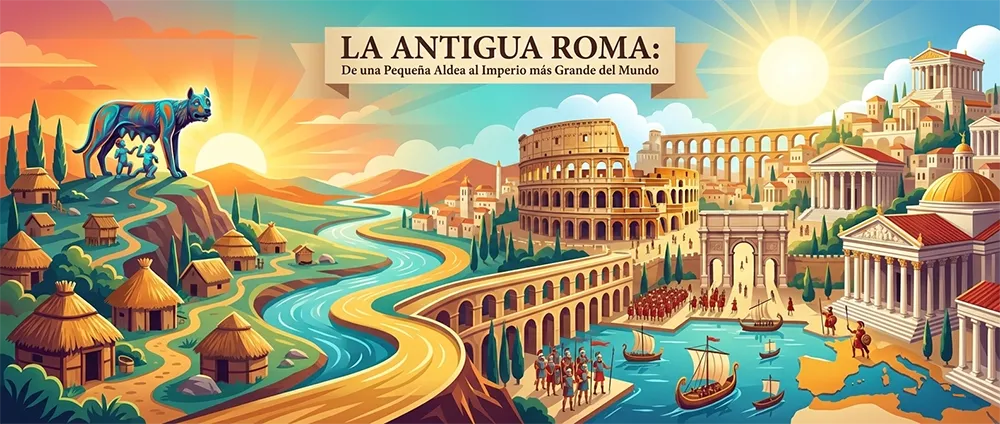
1. The Origin: How did it all begin? (753 BC)
Rome’s history has two versions: the magical legend and the historical reality. Both are important!
-
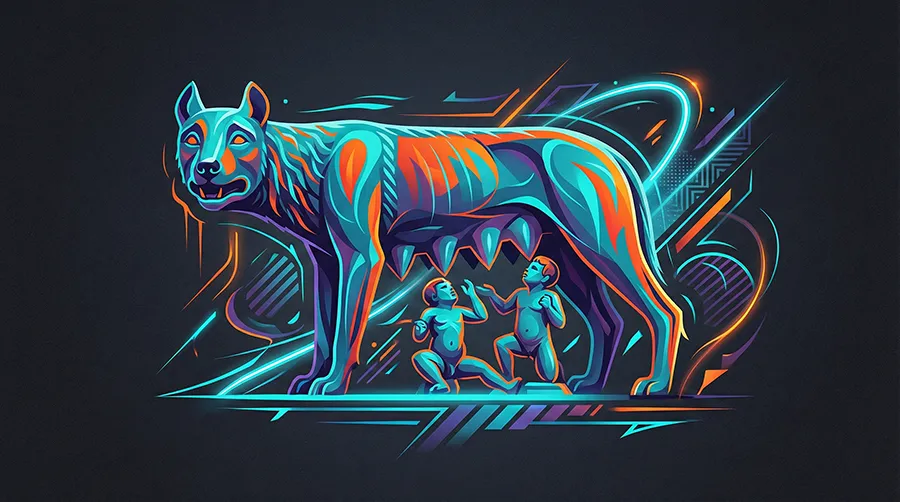
The Legend: They say that two twin brothers, Romulus and Remus, were abandoned in a basket in the Tiber River. A she-wolf (the famous Capitoline Wolf) heard them crying, rescued them, and nursed them as if they were her own cubs. When they grew up, they decided to found a city on that spot. After a fight between the brothers, Romulus became the first king. According to tradition, this happened on April 21, 753 BC.
-
The History: In reality, Rome was born from the union of several tribes of shepherds and farmers who lived on seven hills near the Tiber River. They joined together to become stronger and protect each other.
2. The Three Ages of Rome: How were they ruled?
Rome wasn’t always the same. Over more than 1,000 years, they changed their way of ruling three times:
-
The Monarchy (753 BC – 509 BC): In the beginning, Kings were in charge. There were seven kings in total. The last one was so cruel that the Romans kicked him out and said: “Never again a king!”
-
The Republic (509 BC – 27 BC): Power to the people (and the Senate)! This is when voting was invented, and the Roman Senate made the important decisions. They wrote SPQR everywhere (Senatus Populusque Romanus – The Senate and the People of Rome). This was the era of great expansion across the Mediterranean.
-
The Empire (27 BC – 476 AD): After civil wars, Augustus appeared as the first Emperor. The Emperor held all the power. This was the age of maximum glory, construction, and wealth.

The Roman Senate: The “Wise Men” who led Rome
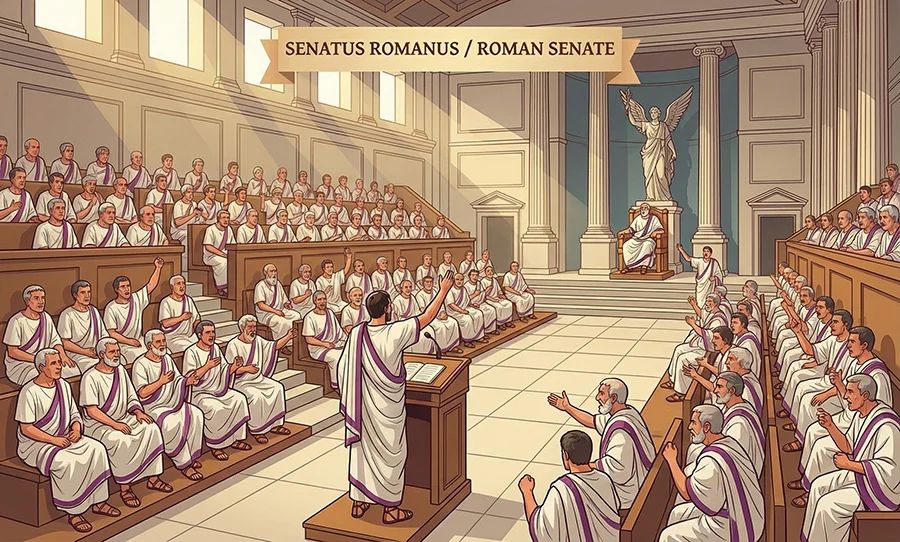
If you look at any Roman standard, you will see four famous letters: S.P.Q.R. It stands for “The Senate and the People of Rome.” Even when there were kings or emperors, the Senate was always the heart and brain of Rome.
What exactly was it?
It wasn’t like today’s parliaments where laws are voted on every day. Originally, it was a “Council of Elders” (in fact, the word Senate comes from senex, which means “old man” in Latin). Their main job was to advise the consuls and control two very important things: public money and foreign policy (wars and peace treaties).
How did it work?
-
The Place: They met in a building called the Curia, located in the Roman Forum.
-
The Uniform: Senators wore a white toga with a wide purple stripe. It was their status symbol!
-
The Debates: They were famous for their incredibly long speeches. There were no microphones, so they had to be great orators to convince others with their powerful voices. The most famous senator for his “golden tongue” was Cicero.
Senate Fun Facts:
-
A Job for Life: Once you entered the Senate, you were a senator forever (unless you did something very bad and were expelled).
-
Watch out for the daggers!: The Senate could be a dangerous place. It was right there where a group of senators assassinated Julius Caesar because they thought he was becoming too powerful.
-
A Senator Horse?: Story goes that the “mad” emperor Caligula wanted to name his favorite horse, Incitatus, as a consul (head of the senate). He wanted to prove that the senators were so useless that even a horse could do a better job!
3. Engineers of the Ancient World: Their Great Achievements
The Romans were geniuses of construction. They didn’t just make things beautiful; they made useful things that lasted for centuries.
The Roads: “All roads lead to Rome.” They built thousands of miles of perfectly straight stone roads so their armies and merchants could travel fast. They were the highways of antiquity!
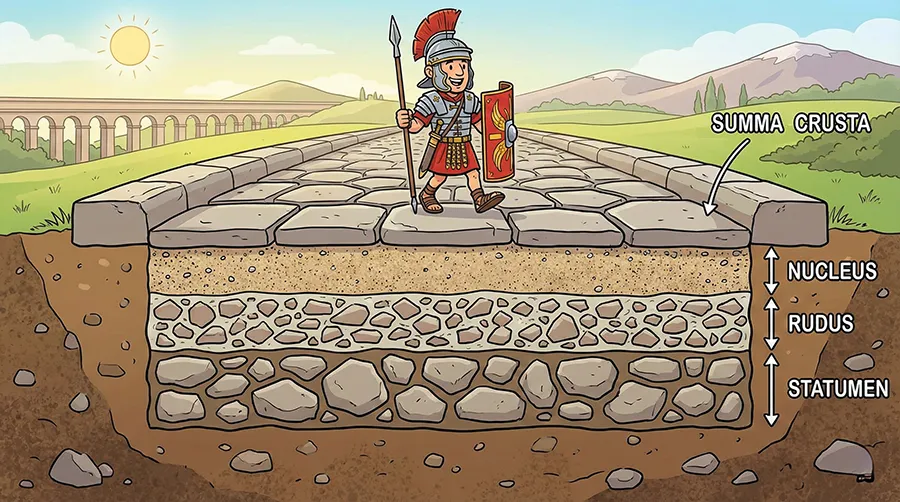
The Aqueducts: How do you bring fresh water to a huge city? With giant stone slides! Aqueducts transported water from the mountains all the way to the city’s fountains and baths.
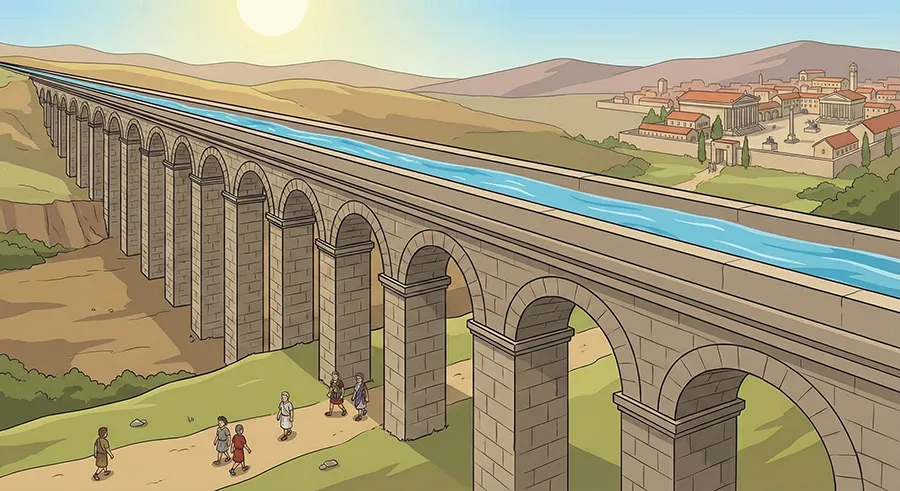
Roman Concrete: They invented a type of cement so good that many of their buildings, like the Pantheon, are still standing 2,000 years later.

4. Daily Life: How did the Romans live?
Life in Rome was bustling and noisy. Imagine a modern city but without traffic lights! The streets were always crowded with people from every corner of the Empire. In the mornings, the smell of freshly baked bread mixed with the shouts of merchants selling everything at the top of their lungs, from sandals to exotic spices. Curiously, Romans loved eating out; there were street-side counters called Thermopolium where they served hot fast food—they were the ancestors of our fast-food restaurants! It was a true labyrinth of colors, smells, and sounds where senators, soldiers, and peasants crossed paths every day. Take a look at these illustrations of Ancient Rome.
The Houses
The wealthy lived in Domus, large houses with an inner courtyard and a garden.
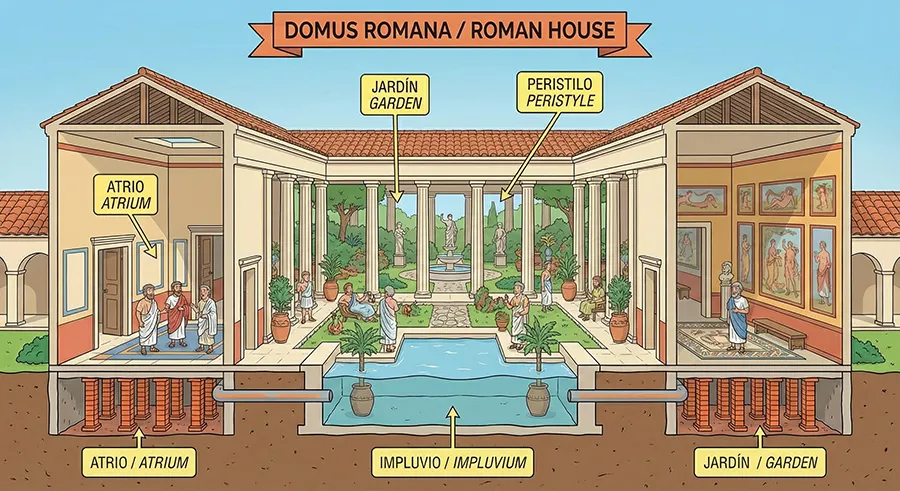
Most people lived in Insulae, multi-story apartment buildings (yes, they had flats just like us!), but they were small, made of wood, and sometimes dangerous.

Leisure and entertainment
Romans loved a good show. They went to the Colosseum to watch gladiator fights (they were the rock stars of the era!) or to the Circus Maximus to watch thrilling chariot races (carts pulled by horses).
Gladiators: Rome’s Bravest “Athletes”!
If you thought today’s football players are famous, wait until you meet the gladiators! They were the true stars of antiquity and filled giant stadiums like the Roman Colosseum.
Who were they? Most were slaves or prisoners who were trained in special schools (called ludus) to fight. But there were also free men who chose to be gladiators for the fame and the money. They wore awesome armor and helmets that covered almost their entire faces!
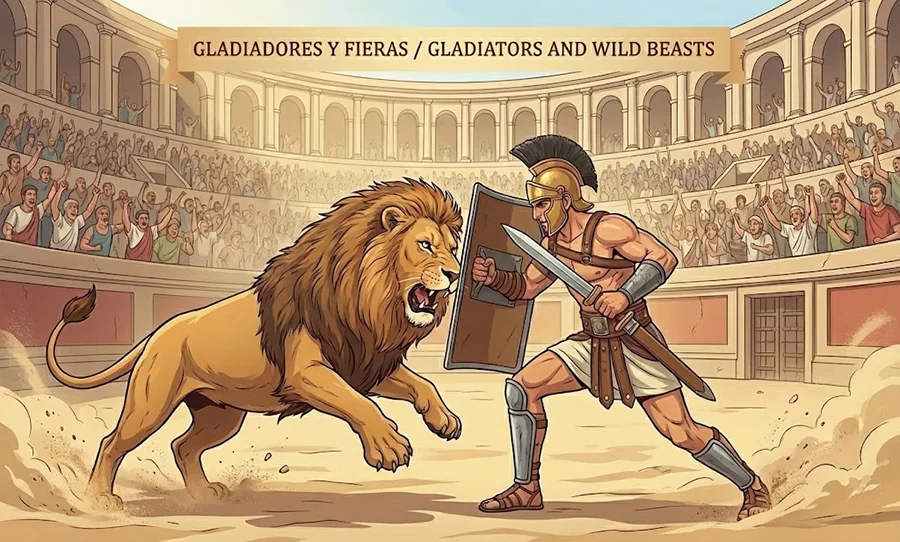
The Show: The matches weren’t just street fights. There were referees, rules, and different types of gladiators: some carried nets and tridents, others large shields and short swords. Sometimes, to make it even more exciting, they had to face wild animals brought from Africa, like lions, tigers, or elephants.
Did you know? Not all matches ended badly. Training a gladiator cost a lot of money, so if they fought well, the audience and the Emperor would usually spare their lives even if they lost. They were very valuable!

The Baths
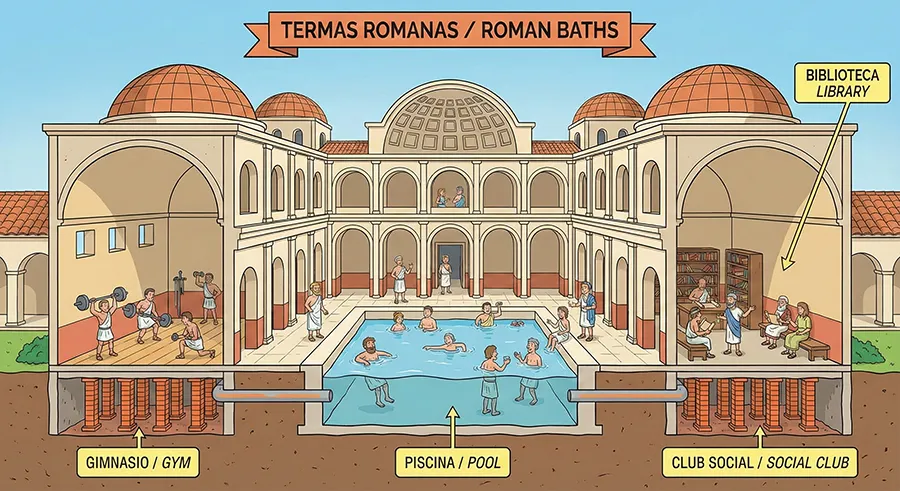
The baths (thermae) were giant public bathing complexes. But people didn’t just go there to wash; they went to exercise, read in the library, and chat with friends. It was Rome’s social club!
5. The Roman Army: The unstoppable machine
The secret to Rome’s power was its army: The Legions. They weren’t just strong; they were highly disciplined.
-
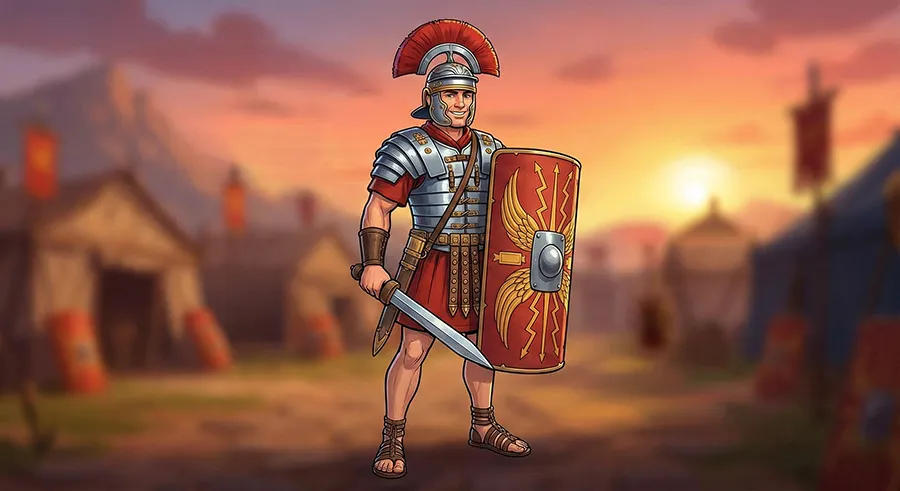
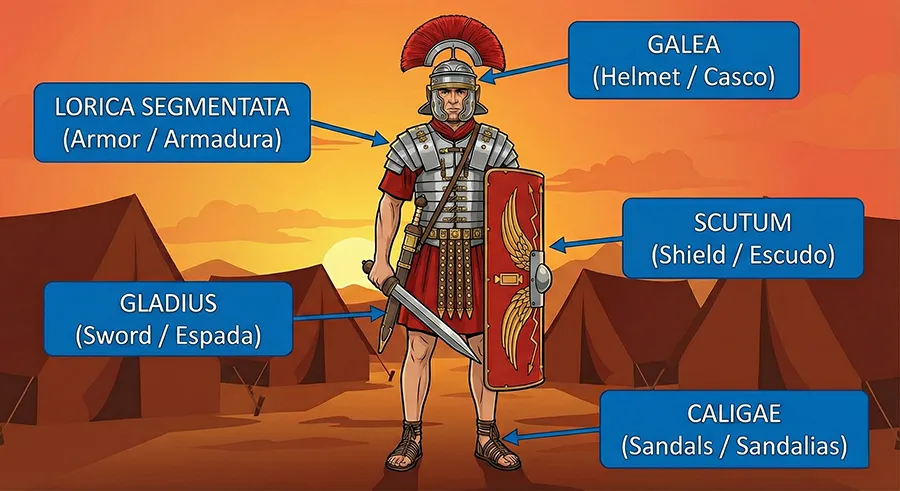
The Legionary: Professional soldiers who were very well-trained. They wore plate armor, a helmet, a large rectangular shield (scutum), and a short sword (gladius).
🛡️ Roman combat formations
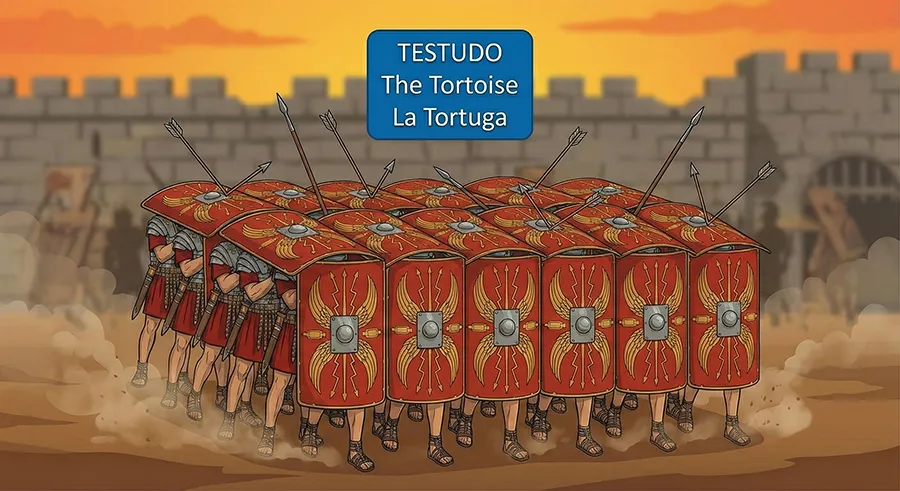
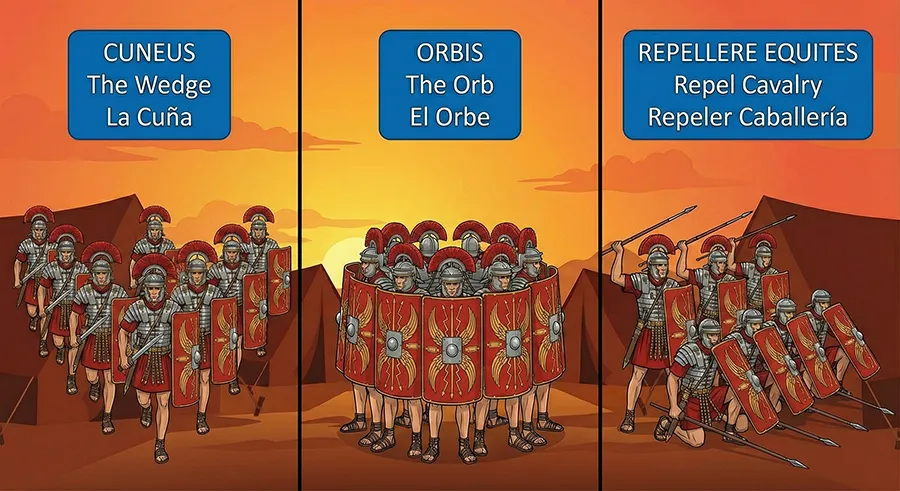
The Roman army didn’t have just one trick! They were masters of tactics and had a formation for every situation on the battlefield. Besides the famous Testudo, they used other ingenious strategies to defeat their enemies.
-
The Tortoise (Testudo): A famous formation where soldiers joined their shields over their heads to protect themselves from enemy arrows, looking like an armored shell.
-
The Wedge (Cuneus): Imagine a giant human arrow. Soldiers formed a triangle with the point facing forward to break through enemy lines. It was perfect for attacking!
-
The Orb (Orbis): When surrounded and in danger, they formed a perfect defensive circle, like a hedgehog of shields and spears, protecting themselves from all sides.
-
Repelling cavalry (Repellere equites): To stop a horse charge, the first row would kneel and dig their shields into the ground with their spears pointing up, while the second row fired over them. An impenetrable wall of sharp points!
6. The Giant Map: How far did the Romans go?
Imagine you want to walk from England to Iraq, passing through Spain, France, Italy, Greece, and Egypt. Today, you would need a lot of passports! But 2,000 years ago, you could make that entire journey without ever leaving the borders of Rome.
The Romans called the Mediterranean Sea “Mare Nostrum” (Our Sea) because they came to control all the lands surrounding it. They were in three continents at once: Europe, Africa, and Asia!
Who was in charge while the map grew?
Rome didn’t become a giant overnight. It grew in three major phases:
-
The Boot of Italy (The Republic and the Senate): At first, Rome only wanted to control its own home: the Italian Peninsula (the one shaped like a boot). The Senate was in charge here, and the famous acronym was SPQR. They had to fight hard against their neighbors, like the Carthaginians (does Hannibal and his elephants sound familiar?).
-
The Mediterranean and Europe (Julius Caesar and the Generals): Later, great generals like Julius Caesar conquered Gaul (modern-day France) and much of Hispania (Spain). Rome became so rich and powerful that the old system broke down. The generals held more power than the politicians!
-
The Maximum Empire (The Emperors): With the arrival of the Emperors, Rome reached its maximum size (under Emperor Trajan). They reached as far as cold Britannia (England) in the north and the deserts of Arabia in the east. To control so much territory, they divided the map into Provinces, each ruled by a Roman politician who made sure to collect taxes and keep the peace.
Fun fact: Did you know that the names of many modern countries come from Latin?
Hispania = Spain
Gallia = France
Britannia = Great Britain
Germania = Germany

7. Roman Art: Photos in Stone and Colorful Floors!
The Romans weren’t just great engineers and soldiers; they also wanted their empire to be the most beautiful in the world. Although they admired and copied the Greeks a lot, Roman art had a unique and very practical personality.
“Unfiltered” Portraits (Realism)
Unlike the Greeks, who sculpted gods and athletes with perfect, idealized bodies, the Romans loved reality. If an emperor had a big nose, wrinkles, or was going bald, the sculptor made him exactly like that! For them, wrinkles weren’t ugly; they were a symbol of experience and wisdom. Their busts and statues were the “photographs” of the era.
Mosaicos: Los primeros píxeles
Have you noticed the battle scene in the background? It’s not painted—it’s a mosaic! Romans decorated the floors of their homes and baths with thousands of tiny colored stones called tesserae. When put together, they formed incredible pictures. It is exactly the same idea computer screens use today with pixels.
Propaganda and Power
Art wasn’t just for decoration; it was for showing off. Since there was no television or internet, emperors used statues to say, “Look how strong and powerful I am!” They placed statues of themselves in every square of the Empire so that even the inhabitant of the most distant village would know their leader’s face.
Painting: Fake windows
They hated boring white walls! Inside their homes (like the red painting you see in the image), they painted colorful frescoes that imitated gardens, columns, or mythological scenes to make the rooms feel larger and more luxurious.
5 Representative masterpieces of Roman Art

In the illustration above, we can see 5 representative masterpieces of Ancient Roman art. From left to right and from background to foreground, they are:
-
The Capitoline Wolf (Bottom left): This is the most famous bronze sculpture of the Roman legend. It shows the she-wolf, Luperca, nursing the twins Romulus and Remus, the mythical founders of the city.
-
Fresco from the Villa of the Mysteries (Left wall): That red painting in the background is a recreation of the famous frescoes found in Pompeii. It depicts a mysterious ritual (possibly a wedding or an initiation rite into the cult of Dionysus) and is famous for its incredible state of preservation and its characteristic “Pompeian red” color.
-
Equestrian Statue of Marcus Aurelius (Center, golden): This shows the emperor on horseback with his arm raised. It is the only bronze statue of a Roman emperor to survive intact from antiquity (because it was mistaken for a Christian saint). It represents the power and serenity of the philosopher-emperor.
-
Alexander Mosaic (Right background, floor/wall): That scene with many spears behind the horse is actually a giant mosaic (made of millions of tiny stones). It was found in the House of the Faun in Pompeii and depicts the battle between Alexander the Great and the Persian King Darius. It is one of the most complex works of antiquity.
-
Augustus of Prima Porta (Right foreground): The marble man in armor pointing his finger. This is the first emperor, Octavian Augustus. His breastplate is filled with symbolic reliefs, and the statue was designed to portray him as a perfect, young, and strong leader sent by the gods.
8. The End: The Fall of the Roman Empire (476 AD)
Nothing lasts forever. The Empire became so gigantic that it was impossible to control.
-
The Collapse: There were economic crises, rulers became corrupt, and the army weakened.
-
The Invasions: People from the north (the Barbarians) began to invade the borders.
-
The Final Date: In the year 476 AD, the last Western Roman Emperor—a boy named Romulus Augustulus (curiously, he had the same name as the founder!)—was deposed.
Although the Roman Empire fell, Rome never completely disappeared. They left us a great legacy that is still alive today, as you can read in the next section. We are still a little (or quite a lot) Roman today!
9. The Legacy: Rome is still among us!
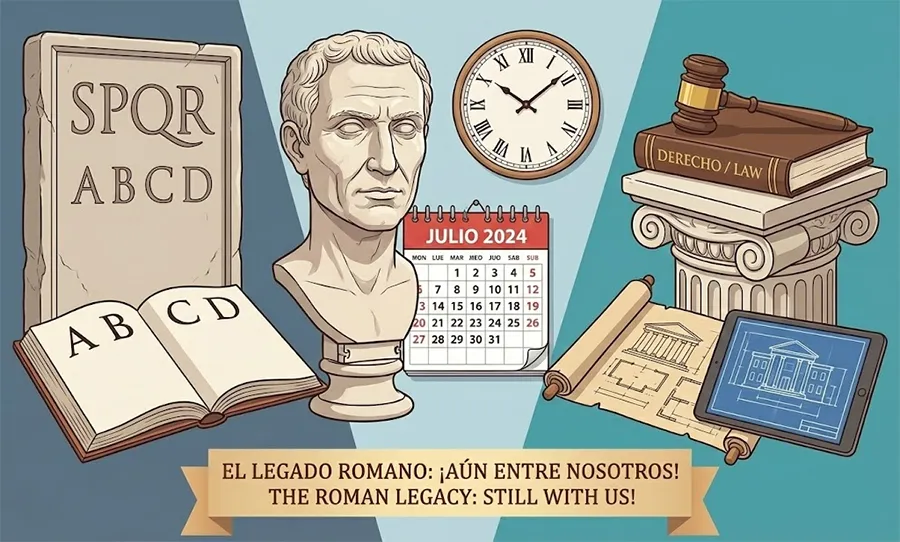
Sometimes we think the Roman Empire disappeared a long time ago, but… surprise! In reality, you use things invented by the Romans every single day, from the moment you wake up until you go to bed.
Don’t believe it? Look at everything they left us as an inheritance:
-
Your Language (Latin): If you speak Spanish, French, Italian, or Portuguese, you are speaking a modern version of Latin! Also, we use their alphabet to write (A, B, C…). Without them, you wouldn’t be able to read this.
-
The Calendar: Do you know why the year has 365 days and 12 months? Because Julius Caesar decided so! In fact, the month of July is named after him, and August after Emperor Augustus.
-
Laws and Justice: The idea that “everyone is innocent until proven guilty” or that we need lawyers and judges to solve problems comes directly from Roman Law.
-
Roman Numerals: Although we use Arabic numerals (1, 2, 3…) for math, Roman numerals (I, V, X, L, C, D, M) are still alive on old clocks, in book chapters, and to name kings and popes.
- Their Architecture: Many civil and religious works are still in use today or at least in great condition. For example, the Aqueduct of Segovia, numerous bridges across what was once their empire, remains of Roman roads, theaters like the one in Mérida, temples, and more.
In conclusion, Rome started as a small village of shepherds and ended up building the foundations of our modern world. Nothing more and nothing less!
We hope you enjoyed this content and the collection of Ancient Rome drawings. Now, if you want to continue the adventure and explore other eras of humanity’s exciting history, we invite you to visit these sections.