


What are the 12 Principles of Animation?
Before picking up a pencil or opening your animation software, it is fundamental to understand that animation is not simply about ‘moving drawings.’ The true magic lies in creating the illusion of life.
These 12 principles are a set of basic rules that serve as the theoretical and technical foundation for any animator, whether working in traditional 2D, stop-motion, or 3D.
The Origin: Disney’s ‘Nine Old Men
In the early 1930s, animators at Walt Disney Studios faced a challenge: how to make characters feel real, with weight and emotions, instead of just simple, flat silhouettes?
After years of experimentation, two of the studio’s most legendary animators, Frank Thomas and Ollie Johnston (members of the elite group known as the ‘Nine Old Men’), compiled these findings in the book The Illusion of Life (1981). This book is considered the ‘Bible of animation’ today.
What do these rules represent?
The 12 principles are not rigid rules, but rather a guide to:
-
Simulate the laws of physics: Such as gravity, inertia, and volume.
-
Add appeal: Making characters charismatic and eye-catching.
-
Narrative clarity: Ensuring the viewer understands exactly what is happening on screen.
Mastering these concepts is what sets an amateur apart from a professional. Next, we are going to break them down one by one so you can apply them to your own projects.
1. Squash and Stretch
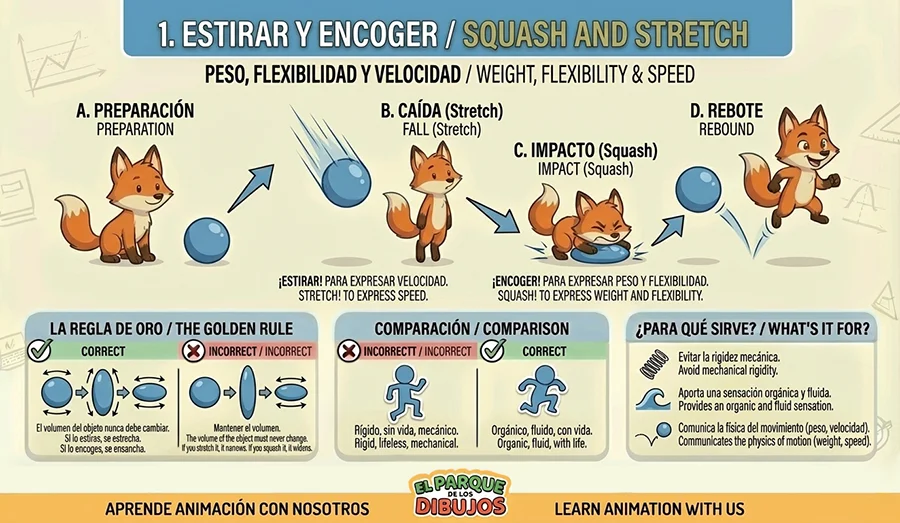
It is considered the most important principle. It consists of deforming an object to give a sense of weight, flexibility, and speed.
-
The concept: When a ball bounces, it “stretches” as it falls and “squashes” (flattens) upon impacting the ground.
-
The golden rule: The object’s volume must never change. If you stretch it vertically, it must narrow horizontally to maintain its mass.
-
What it’s for: To avoid rigidity and provide an organic, fluid feel.
2. Anticipation
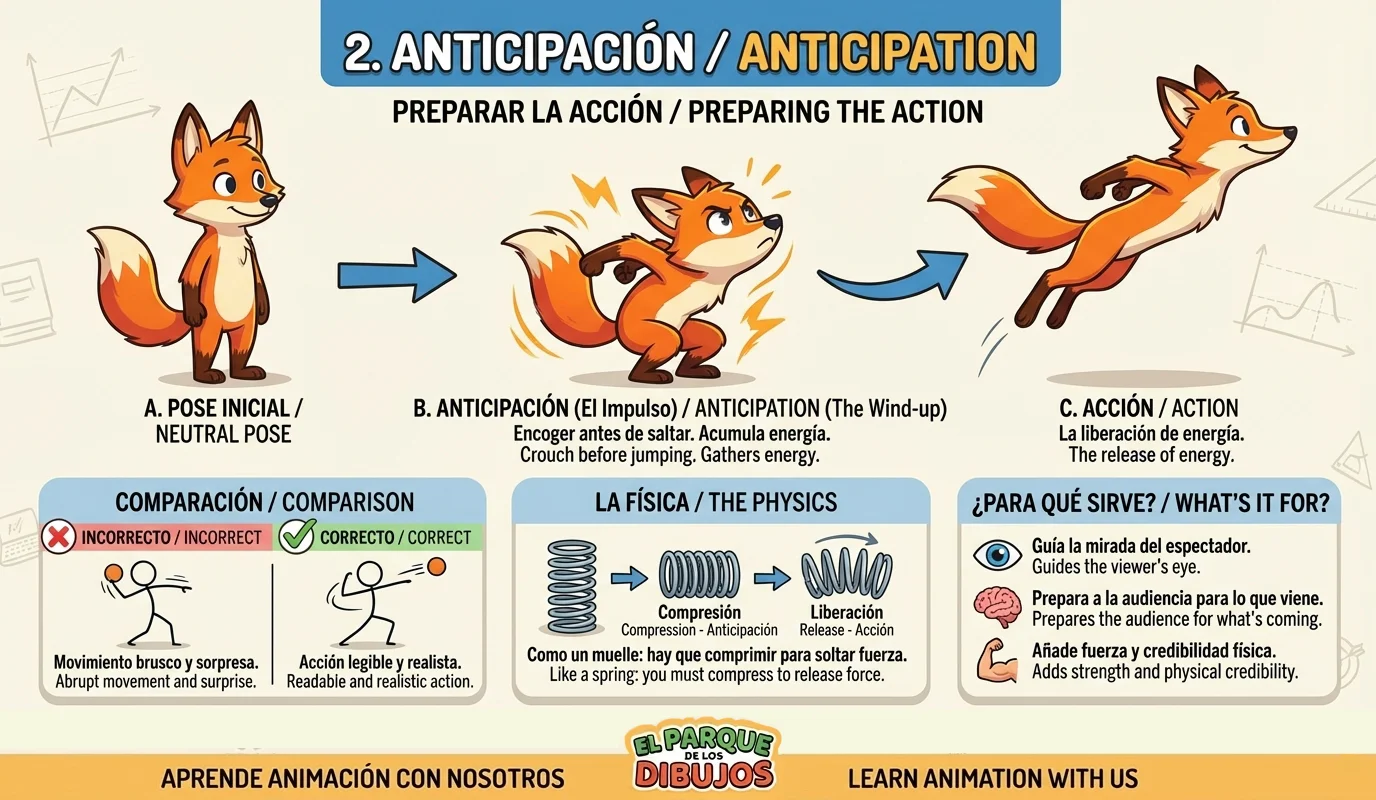
It prepares the audience for the action that is about to occur.
-
The concept: Before a character starts running, they must crouch and lean their body back. It is the “momentum” or “build-up” beforehand.
-
What it’s for: It helps the viewer understand what is going to happen before it actually does, making the action more realistic and readable. Without anticipation, movements appear abrupt and artificial.
3. Staging
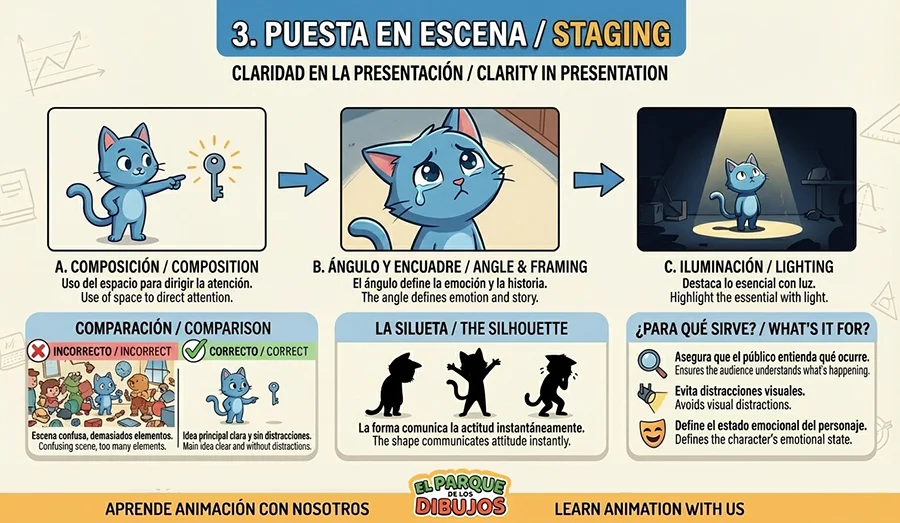
It is the art of presenting an idea in a way that is completely clear to the viewer.
-
The concept: Using composition, camera angles, and lighting to direct the audience’s gaze toward what is important.
-
What it’s for: To eliminate distractions. Good staging defines whether a character’s attitude is one of sadness, fear, or joy through their silhouette and position within the frame.
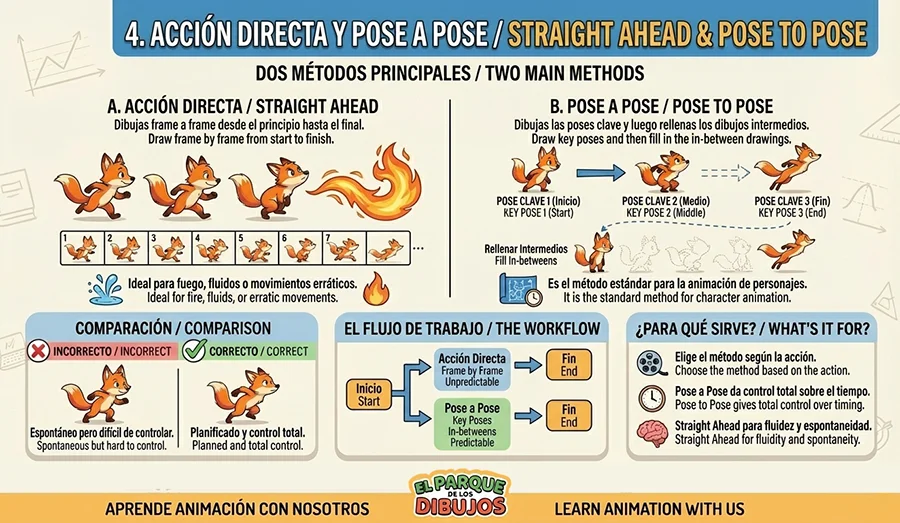
4. Straight Ahead Action and Pose to Pose
These are the two main methodologies for animating.
-
Straight Ahead Action: You draw frame by frame from the beginning to the end. It is ideal for fire, fluids, or erratic movements.
-
Pose to Pose: You draw the key poses (beginning, middle, and end) and then fill in the intermediate drawings (in-betweens). This is the standard method for character animation, as it allows for complete control over timing and spacing.
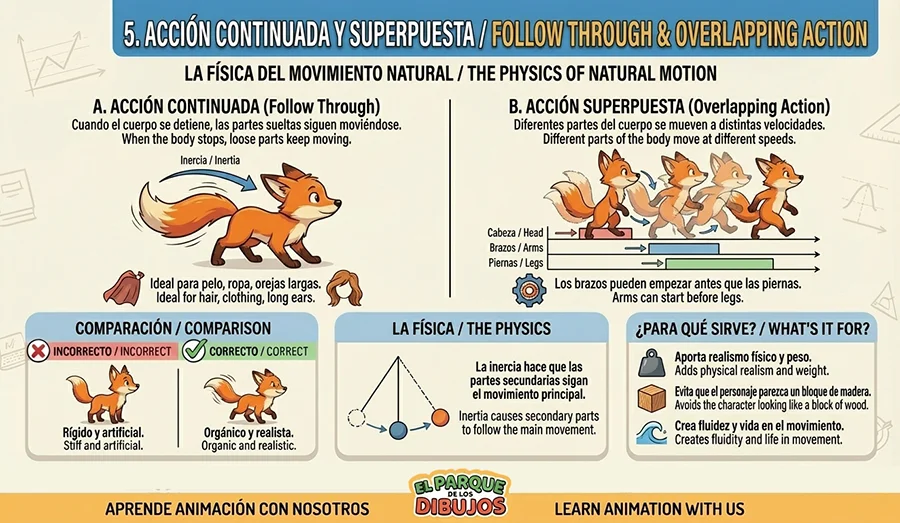
5. Follow Through and Overlapping Action
Nothing in nature comes to a sudden stop.
-
Follow Through: When the body stops, the “loose” parts (hair, clothing, long ears) continue moving due to inertia before coming to a rest.
-
Overlapping: Different parts of the body move at different speeds. The arms might start moving before the legs have finished their step.
-
What it’s for: It provides physical realism and prevents the character from looking like a block of wood.
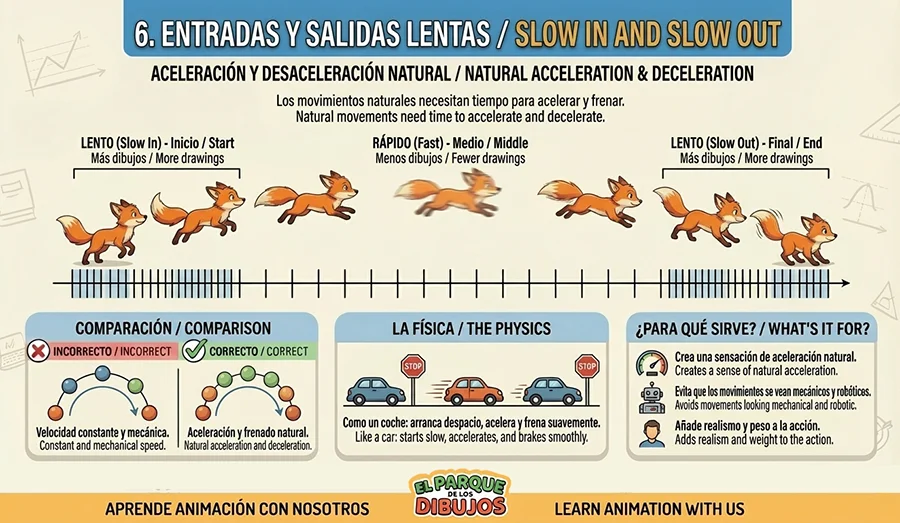
6. Slow In and Slow Out
Natural movements need time to accelerate and decelerate.
-
The concept: It consists of adding more drawings at the beginning and the end of an action, and fewer drawings in the middle.
-
What it’s for: It creates a sense of natural acceleration. Without this principle, movements look mechanical and robotic (constant speed).
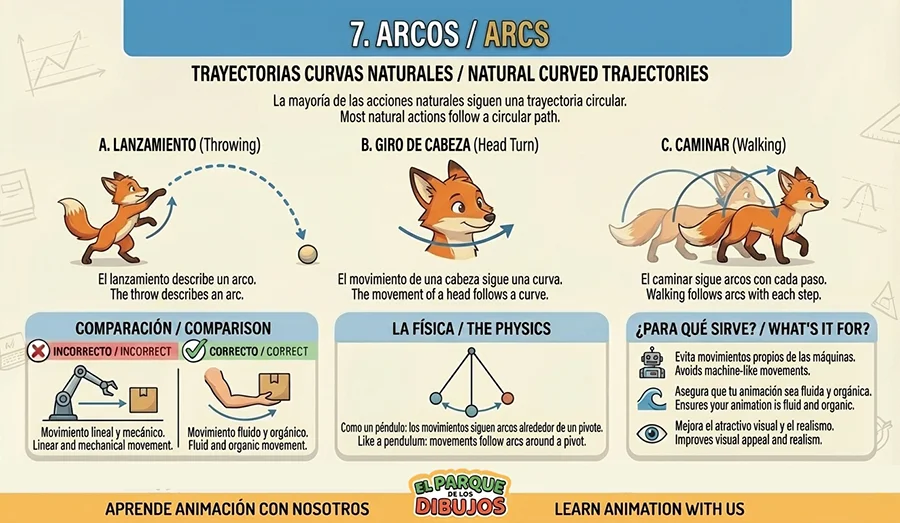
7. Arcs
Most natural actions follow a circular path.
-
The concept: The movement of a head turning, the swing of a hand, or a person walking always describes an arc.
-
What it’s for: Straight-line movements are characteristic of machines. If you want your animation to be fluid and organic, make sure your trajectories follow curves.
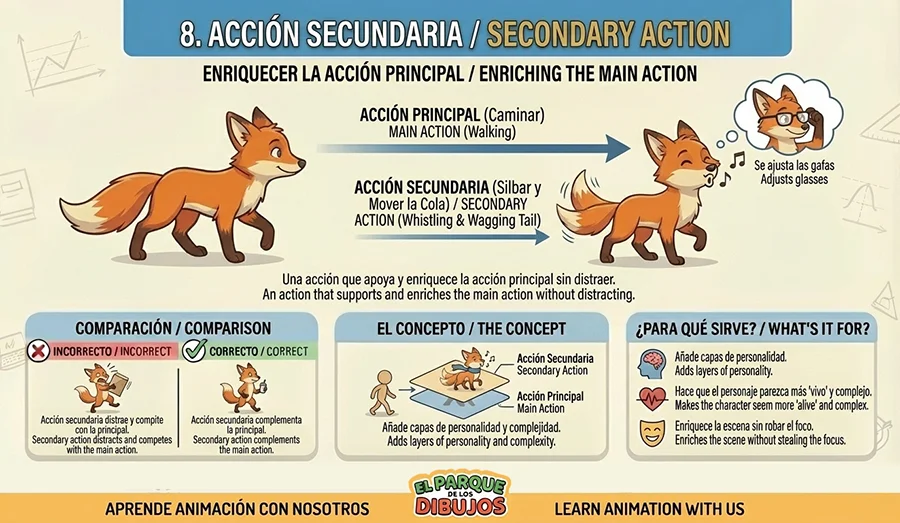
8. Secondary Action
It is an action that supports and enriches the main action without distracting from it.
-
The concept: A character walks (main action) while whistling or adjusting their glasses (secondary action).
-
What it’s for: It adds layers of personality and makes the character appear more “alive” and complex.
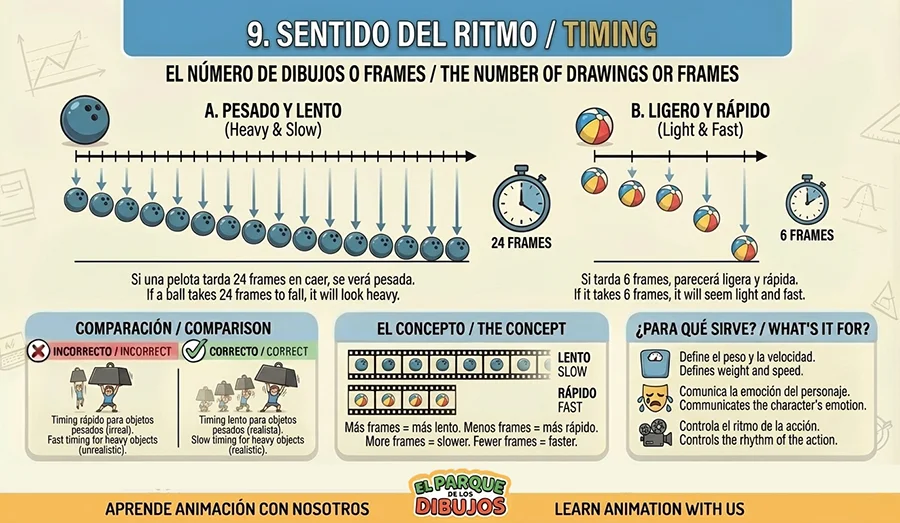
9. Timing
It refers to the number of drawings or frames that an action takes.
-
The concept: If a ball takes 24 frames to fall, it will look heavy. If it takes 6 frames, it will appear light and fast.
-
What it’s for: Timing defines weight, speed, and, most importantly, the character’s emotion.
10. Exaggeration
Animation should not be an exact copy of reality, but rather an accentuated version of it.
-
The concept: If a character is sad, make them extremely languid. If they are surprised, make their eyes pop out of their sockets.
-
What it’s for: It helps communicate the essence of the action more clearly and entertainingly. Exaggeration makes the animation “readable” and fun.

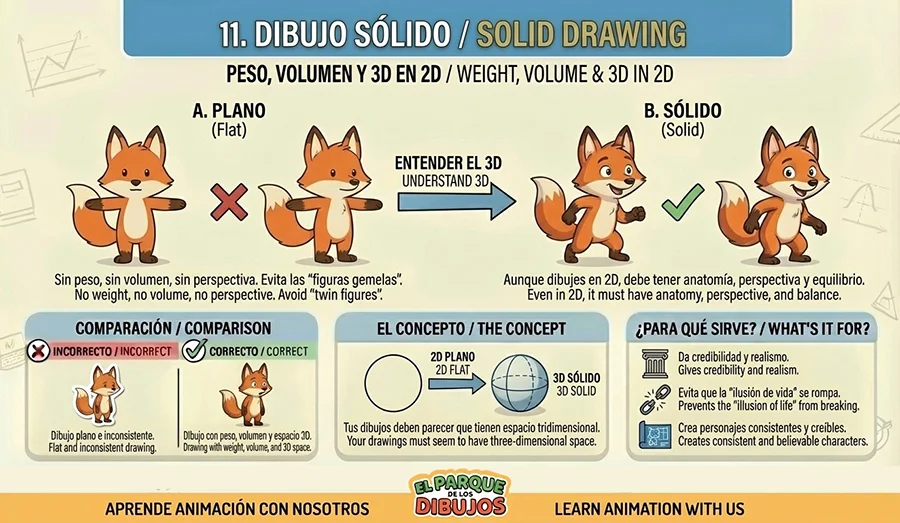
11. Solid Drawing
Your drawings must appear to have weight, volume, and three-dimensional space.
-
The concept: Even if you are drawing in 2D, you must understand anatomy, perspective, and balance. Avoid “twin figures” (arms and legs in the exact same symmetrical position).
-
What it’s for: It provides credibility. If the drawing is flat or inconsistent, the “illusion of life” is broken.
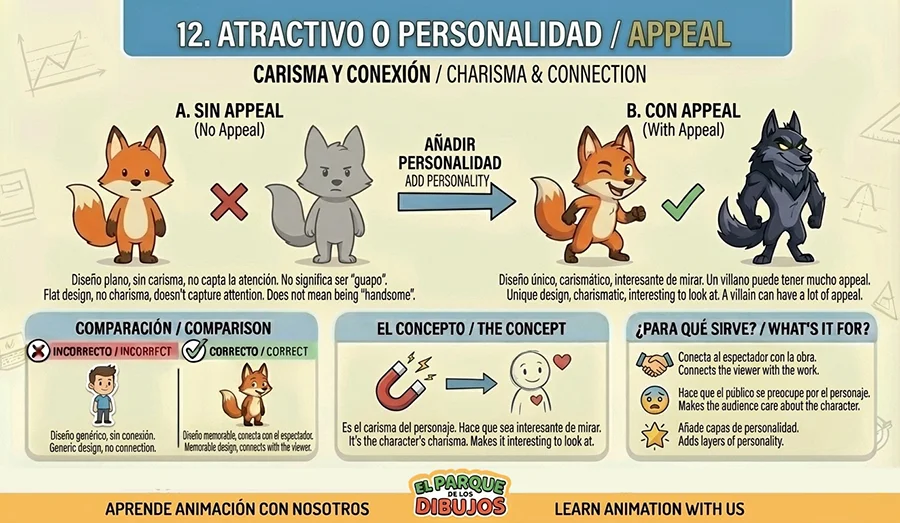
12. Appeal
It is the character’s charisma.
-
The concept: It doesn’t mean the character has to be “handsome,” but rather that they are interesting to look at. A villain can have a lot of appeal if their design and movement are magnetic.
-
What it’s for: It is what connects the viewer to the work. A solid design combined with animation full of personality makes the audience care about what happens to the character.
You can purchase the book ‘The Illusion Of Life: Disney Animation’ by Frank Thomas and Ollie Johnston on Amazon by clicking the image or here. In the book, the authors—who worked on numerous classic Disney films—formulate the famous 12 principles of animation. This is an essential work for anyone who loves the world of animation. This book will help you better understand animated masterpieces and create more effective and impactful animations, whether you are a professional or simply want to animate for fun

In Frank Thomas and Ollie Johnston’s book, besides explaining the technical side and the concepts behind these 12 principles of animation, we can appreciate all the magic and beauty of animated art.