



Woody Woodpecker
Woody Woodpecker: The King of “Ha-Ha-Ha-Ha!”
Welcome to the ultimate section on Woody Woodpecker on El Parque de los Dibujos. Here, you will find his complete history, his transition from the big screen to television, production trivia, iconic supporting characters, and the lasting legacy he continues to leave across animation history.


If you are passionate about cartoons and the history of animation in general, visit our YouTube channel. here. Follow us on our social media to stay up to date with our new content and join us on this journey through the animated world.
Birth of a Woodpecker (1940)
Creators: Walter Lantz (producer) and Ben Hardaway (writer and animator). Hardaway was also the co-creator of Daffy Duck and Bugs Bunny.
Inspiration: A real-life woodpecker kept pecking away at Lantz’s honeymoon cabin; his wife, Grace, suggested turning the nuisance into a cartoon character.
First Short: Knock Knock, released on November 25, 1940. Woody originally debuted with bug eyes, a toothy beak, and an unhinged “screwball” personality—a term in animation describing an eccentric, highly unpredictable, and chaotic character who rejects conventional logic to drive wild, exaggerated comedy.
The Original Laugh: Recorded by Mel Blanc, the era’s premier voice actor and the legendary voice behind countless iconic cartoon characters.
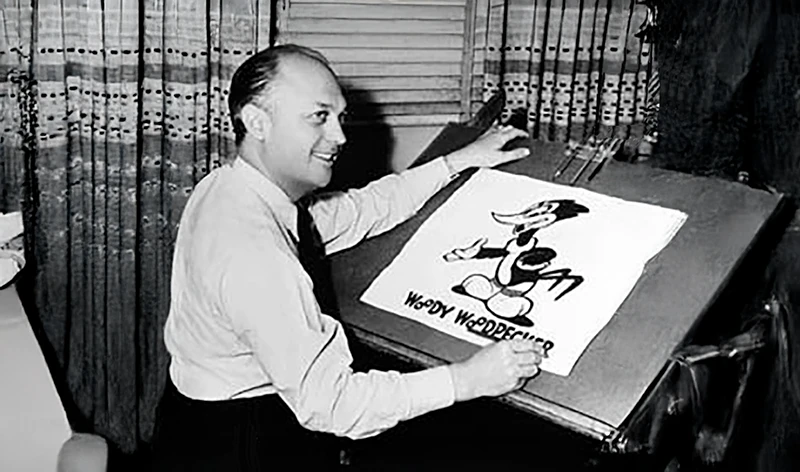

Woody Woodpecker, original comic book cover from 1959

Woody Woodpecker, original comic book cover #1

Woody Woodpecker, original comic book cover #2
A Real-Life Woodpecker Inspires an Animated Legend
In 1940, producer and director Walter Lantz was enjoying his honeymoon in a cabin at Lake Sherwood, California. Every morning, a wild woodpecker relentlessly hammered on the roof. His wife, Grace, uttered the line that would change everything:
“Walter, since you can’t shut him up… turn him into a cartoon!”
Lantz, who had been directing shorts for Universal Pictures for over a decade, reached out to writer-animator Ben “Bugs” Hardaway (co-creator of Daffy Duck and the earliest iteration of Bugs Bunny). Together, they drafted a “screwball” character just as loud and chaotic as that real-life bird.
The result debuted on November 25, 1940, in the short Knock Knock: complete with bug-eyes, a toothy beak, an iconic laugh recorded by Mel Blanc, and an unhinged urge to drill through everything in sight. Audiences were instantly hooked.
Woody Woodpecker Image Gallery to Download

Episode frame from Woody Woodpecker: "Lotsa Luck"

Woody Woodpecker with Wally Walrus

Woody Woodpecker, a character created by Walter Lantz

Intro episodio El Pájaro Loco

Woddy Woodpecker, color by Technicolor

Woody Woodpecker in a classic episode scene

Woody Woodpecker wearing glasses

Woody Woodpecker, cartoon star

The Woody Woodpecker Show in the modern era
Who Was Walter Lantz and How Did He Join Universal?
-
Roots in Silent Animation A New Yorker of Italian descent, Lantz got his start as a cartoonist at the John R. Bray Studio in 1916.
-
Oswald the Lucky Rabbit. When Walt Disney lost the rights to Oswald to Universal in 1928, the studio hired Lantz to take over the series. There, Lantz learned how to produce, direct, and negotiate, quickly rising to head Universal’s animation department.
-
Walter Lantz Productions. In 1935, Universal granted Lantz ownership of the animation unit in exchange for exclusive distribution rights. This birthed his self-named production company, which would maintain an exclusive distribution partnership with Universal for nearly four decades.
-
Independent Financing Unlike Disney or Warner Bros., Lantz had to self-finance many of his cartoons, negotiating loans from Universal short-by-short. Whenever production costs soared, he had to downsize staff or temporarily pause operations altogether (notably in 1940–41 and 1949–50).

Design Evolution of Woody Woodpecker and His Iconic Voice
-
The “Wild” Era (1940–1944): Ultra-fast animation, a toothy beak, and Mel Blanc’s strident, unhinged laugh.
-
Shamus Culhane’s Refinement (1944–1946): Director Culhane smoothed out Woody’s beak and clearly defined his blue body and white chest. Features included vibrant colors and experimental visual gags (such as the famous perspective leap in The Barber of Seville).
-
The Dick Lundy Era (1947–1949): A slightly less aggressive Woody with a sleeker, more “modern cartoon” design.
-
The Television Transition (1955 onwards): Redesigned with larger eyes, a friendly expression, and a softer personality tailored for the new young TV audience. Grace Stafford (Lantz’s wife) provided his definitive voice, introducing warmer tones while preserving the signature laugh.
-
Voice Actor Lineup: Mel Blanc → Danny Webb → Kent Rogers → Ben Hardaway.
-
1950: Grace Stafford, Walter Lantz’s wife, takes over as the definitive voice of Woody. She initially kept her identity a secret until curious fans demanded to know who was behind the iconic laugh.


Fun Fact: The very first Woody Woodpecker short was titled “Knock Knock” (released in 1940), produced by Walter Lantz and distributed by Universal Studios. In those early shorts, Woody sported gapped teeth, a heavy chin, stocky legs, an oversized beak, and a red chest.
In 1947, songwriters George Tibbles and Ramey Idriss composed “The Woody Woodpecker Song.” It earned an Academy Award nomination and became a gold record—the first time a cartoon character’s theme song climbed the top music charts.
The orchestral scores by Darrell Calker, followed by Clarence Wheeler’s jazz arrangements, brought big-band saxophones and trumpets into the mix. The music was meticulously synchronized with every beak-slam and door-bang that defined the series’ iconic slapstick comedy.
“The Woody Woodpecker Song” (1947) by George Tibbles & Ramey Idriss, performed by Gloria Wood and Harry Babbitt.
You can listen to the song on YouTube via this link:
: https://www.youtube.com/watch?v=YdQSrdZM7aI
It received an Academy Award nomination in 1948 and sold over a million copies—a record-breaking feat for a cartoon theme song.
Shorts Score Composers: Darrell Calker → Clarence Wheeler.
Features a light-jazz, big-band style packed with musical gags that highlight the frenetic comedy.

Unforgettable Supporting Characters of Woody Woodpecker
Wally Walrus: A good-natured Scandinavian walrus whose patience is constantly tested by Woody’s antics.
Buzz Buzzard: A scheming vulture and opportunistic villain who embodies Wild West trickery.
Ms. Meany: A hot-tempered, cranky landlady who hates the bird’s chaos—a pioneer of the classic “landlady” archetype. Known for her grumpy, short-fused demeanor, she easily explodes over the slightest annoyance. As Woody’s landlady, she is always threatening to evict him if he fails to meet strict rental agreements. In The New Woody Woodpecker Show, she is portrayed as an elderly woman living in the same building as Woody and Wally Walrus, adopting a more aggressive and sometimes even violent attitude.
Chilly Willy: An Antarctic penguin simply in search of warmth and food. He starred in his own spin-off series starting in 1953.
Andy Panda: A cute panda cub who co-starred in several shorts. Originally Lantz’s breakout success in 1939, he often became Woody’s unwitting partner.
Winnie Woodpecker: Woody’s girlfriend, debuting in 1954. She offers a romantic and comedic counterweight—sweet, yet tough enough to put a stop to all the madness.

Winnie Woodpecker, Woody Woodpecker's girlfriend

Wally Walrus

Supporting character: Buzz Buzzard the Vulture

Ms. Meany, Woody Woodpecker's landlady

Andy Panda cartoon character

Chilly Willy the Penguin
What is Slapstick? A style of comedy characterized by exaggerated physical action—such as falls, crashes, and smacksticks—designed to provoke quick laughs.
The Slapstick Formula: Woody instigates → the antagonist reacts → total chaos ensues, staying true to the slapstick traditions of Charlie Chaplin, Buster Keaton, and Tex Avery.
From the Big Screen to Living Rooms
-
Theatrical Releases (1940–1956): Shorts originally debuted in cinemas before Universal feature films.
-
TV Syndication (1957): The Woody Woodpecker Show premiered on ABC, blending classic shorts with new segments and live-action introductions by Walter Lantz himself, where he explained the art of animation. The show was later syndicated across dozens of local networks, guaranteeing daily presence during children’s programming hours.
- Corporate Shifts Although Universal handled distribution, the studio was acquired by MCA-Universal in 1966. Lantz renegotiated his contract to retain the TV and merchandising rights.
The Result: Woody solidified his status as a global icon for kids and audiences of all ages across the United States, Latin America, and Europe.

Rising production costs, industry crisis, and the studio closure.
In the 1960s, animation production grew increasingly cheap, dominated by Hanna-Barbera and the limited “UPA” style. The costs of producing theatrical shorts were no longer financially viable. Operating with a crew of just 32 employees, Walter Lantz Productions permanently closed its doors in 1972 after releasing the short Bye Bye Woody, leaving behind an impressive legacy of 196 Woody Woodpecker episodes. Nevertheless, Lantz retained creative control and supervised television re-releases until his passing in 1994.

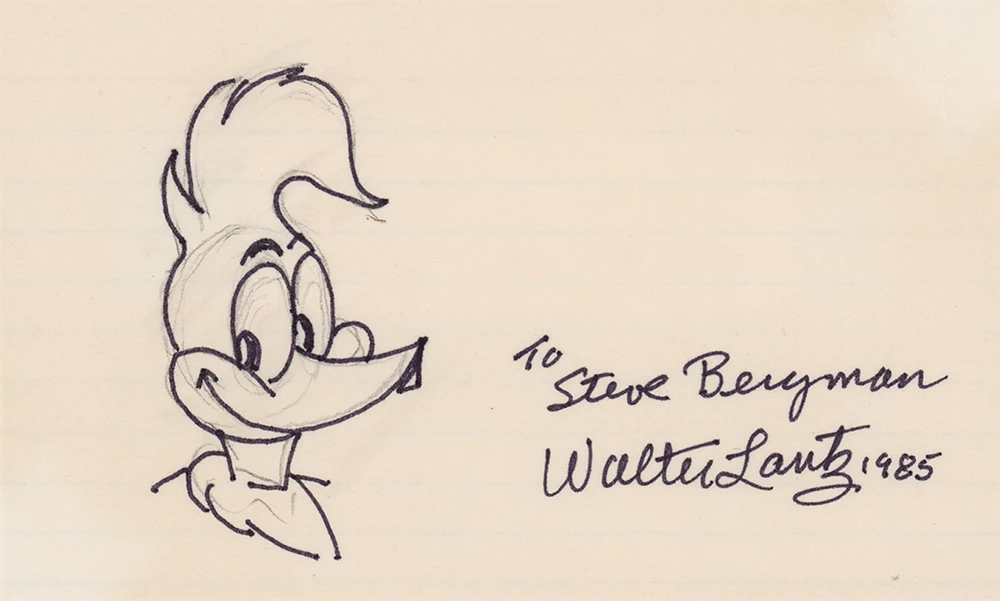
Starting in 1999, Woody Woodpecker experienced a brand revival. He starred in new TV series, comic books, and video games. A pivotal moment in this rebirth arrived with his digital comeback in 2018, marked by the launch of official multilingual YouTube channels featuring fully restored classic shorts alongside brand-new 2D digital episodes.
Canal de Youtube en español de El Pájaro Loco:  / @elpajaroloco
Official English Woody Woodpecker YouTube Channel: / @woodywoodpecker

1979: Walter Lantz receives an Honorary Academy Award for creating Woody Woodpecker.
1990: Woody gets his star on the Hollywood Walk of Fame.
Brazil & Mexico: Local dubbing made his laugh an undeniable cultural phenomenon across Latin America.
1988: Woody’s iconic “hole-in-the-door” gag makes a cameo appearance in Who Framed Roger Rabbit.
1995: NASA nicknamed a real-life woodpecker “Woody” after it drilled holes into the Space Shuttle Discovery.
Woody Woodpecker embodies the anarchic, fun-loving freedom of classic animation: he defies logic, social norms, and even authority—all to make us laugh. His unmistakable laughter reminds us that sometimes, the best way to survive chaos is simply to laugh back. Meeting disorder with a smile is the ultimate response. His legacy endures, paving the way for later chaotic characters like Freakazoid and animated versions of Deadpool.