


The Vikings: Explorers, warriors, and navigators of the North!
Welcome to an epic journey through time. The history of the Vikings told through drawings and illustrations comes to life in this unique space, where historical accuracy meets visual impact. Forget dense textbooks; here you can explore the Norse world through the best Viking images, designed to transport you directly to the age of invasions and discoveries.
From the details of their ships to the fury in their eyes before battle, our Viking drawings are designed for you to understand their culture at a glance. If you are looking for Viking illustrations that faithfully capture their clothing, weapons, and homes, you have come to the right place. Get ready to discover how they lived, what they believed in, and how they changed the map of Europe forever.
Prepare your shield and wrap up warm, because we are heading to the frozen North! When we think of Vikings, we imagine tough guys with axes shouting on the beach. But did you know they were also the best sailors of their time, great merchants, and that they reached America 500 years before Christopher Columbus? Discover the truth about these adventurers from Scandinavia.
1. Who were the Vikings and where did they come from? (793 AD – 1066 AD)
The Vikings were not a “country,” but rather peoples of farmers, fishermen, and warriors who came from Scandinavia (what is now Norway, Sweden, and Denmark).
They lived in a very cold land with many fjords (arms of the sea that stretch into the land) and mountains. Since farming the land was difficult there, many decided to set sail in search of fortune, new lands, and adventure. This period is known as the “Viking Age.”
Myth Busted! Helmets with horns? I’m sure you’ve seen Viking drawings with horns on their helmets. But it’s a lie! In reality, they used simple iron and leather helmets, sometimes with a nose and eye guard (spectacle style). Horns would have been very inconvenient in battle (the enemy could easily grab them). This idea was actually invented in a 19th-century opera.

2. Kings of the Sea: Viking Ships or Longships (Drakkars)
The Vikings’ great secret wasn’t their swords—it was their ships! Their vessels, called Drakkars (dragons) or Longships, were the most advanced technology of the era.
-
Fast and light: They could navigate by sail or by oar.
-
Genius Design: They had a very shallow draft. This allowed them to cross deep oceans, but also to navigate shallow rivers and reach the very edge of the beach for surprise landings.
-
Scary Figureheads: On the prow (the front part), they carved heads of dragons or serpents to frighten their enemies and the spirits of the sea.
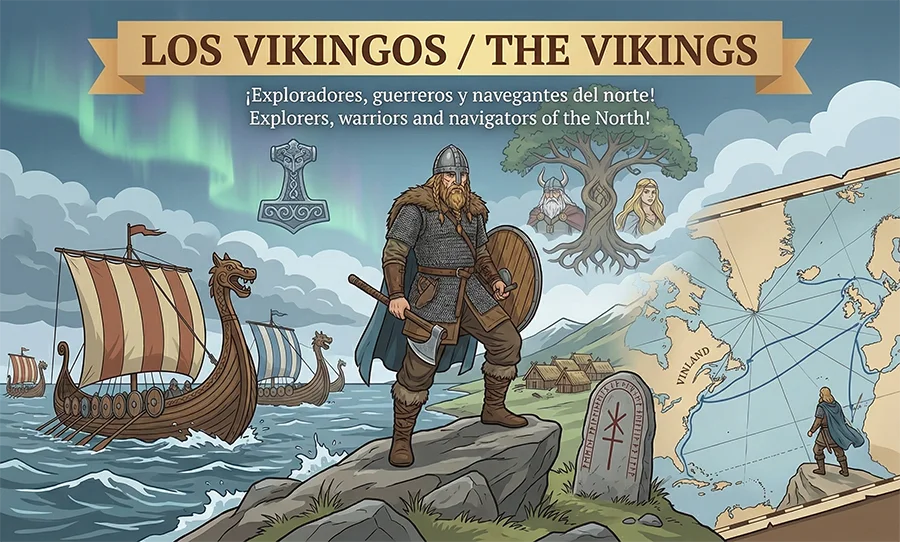
Thanks to these Viking images and their ships, we can appreciate their main feature: the clinker-built hull and its shallow draft. This allowed them to navigate both the open sea and shallow rivers, enabling them to carry out surprise attacks in the heart of Europe.
In these Viking drawings, we wanted to reflect the combination of strength and lightness. A Drakkar could be carried over land if necessary and was flexible enough to withstand the onslaught of the North Atlantic. Seeing these Viking illustrations helps us understand why, upon seeing a square sail on the horizon, coastal peoples knew that history was about to change.


3. Warriors and Berserkers: The Fury of the North
It is true, the Vikings were fearsome warriors. Their favorite weapon was not the sword (which was very expensive), but rather the battle axe and the round, painted wooden shield.
There was a special type of warrior called a Berserker. It is said that they entered battle in a state of uncontrollable fury, almost as if in a trance, biting their shields and feeling no pain. They were absolutely terrifying!

The Shield Wall: Their favorite tactic. They stood shoulder to shoulder, overlapping their shields to create an impenetrable wall against arrows and enemy attacks.

4. The Great Explorers: They reached America!
The Vikings were curious and brave. Using the sun and stars to guide them (and ravens, which they released to see if they could find land), they traveled further than anyone else in their time:
-
To the East: They sailed through the rivers of Russia until they reached exotic Constantinople (Turkey), where they traded in silk and spices.
-
To the West: They discovered Iceland and Greenland.
-
Vinland (America): An explorer named Leif Erikson reached the coasts of Canada (Newfoundland) around the year 1000. They built a settlement there centuries before Columbus was even born! They called it “Vinland” (Land of Wine).

5. Daily Life: The Longhouses
When they weren’t sailing, the Vikings lived on farms. Their houses were elongated and were called Longhouses.
-
All together: They were made of wood, with roofs made of thatch or turf. They had no windows and usually consisted of a single, enormous room with a fire in the center for cooking and keeping warm.
-
Family and animals: Sometimes, in winter, they brought their farm animals into one end of the house so they wouldn’t freeze (and so they could help heat the home)!
-
Viking Women: They had more freedom and rights than other women in Europe at that time. They could own land, request a divorce, and they managed the farm and finances when the men were away traveling.

6. Norse Mythology: Gods, Giants, and the End of the World
The Vikings had a fascinating religion filled with magic. They believed that the universe was held together by a giant tree called Yggdrasil.
-
Odin: The Father of all gods. He was the god of wisdom and war. He had two spy ravens (Huginn and Muninn) and only one eye (he sacrificed the other to gain infinite wisdom).
-
Thor: The god of thunder, the strongest of them all. He protected humans with his magic hammer, Mjolnir, which always returned to his hand whenever he threw it.
-
Loki: The god of mischief and deception. He could change his shape (shapeshift) and was always getting the gods into trouble—though sometimes, he was the only one who could get them back out of it!
-
Valhalla: They believed that if a warrior died bravely in battle, the Valkyries would carry them to a great banquet hall in the sky to train and feast with Odin until the end of time.

7. The Runes: Stones that Speak
The Vikings did not write books on paper. They used an alphabet called Futhark, made up of straight and angular letters called Runes.
They were designed that way so they could be easily carved into wood or stone. They raised large “Runestones” to remember deceased relatives or to boast about their deeds (“Jarlabanke set up this stone and owns this whole village,” says a real one).

8. The Legacy: What did they leave us?
The Viking Age ended, but its mark is still here:
-
Days of the week (in English): Did you know that Thursday means “Thor’s Day,” Wednesday is “Odin’s Day” (Woden), and Friday is “Freya’s Day”?
-
Tecnología Bluetooth: El logo azul de Bluetooth que usas en el móvil son dos runas vikingas (H y B) unidas. Se llama así en honor al rey vikingo Harald Bluetooth, que unificó a las tribus danesas (igual que la tecnología une dispositivos).
-
Words: Words like “iceberg,” “ski,” or “kraken” come from their languages.

We hope this visual journey has helped you better understand who these explorers of the North truly were. The history of the Vikings, told through drawings and illustrations, allows us to connect in a more human and direct way with their deeds, moving away from myths and bringing us closer to their daily reality.
Our image gallery of the Vikings aims to be an educational and artistic tool for everyone passionate about this era. If you enjoyed these Viking illustrations and want to keep exploring more about mythology, combat tactics, or life on Norse farms, don’t forget to share this content. We will continue to expand our collection of Viking drawings so that you never stop learning about this fascinating legacy that still endures today.
Now, if you want to continue the adventure and travel through other stages of humanity’s exciting history, we invite you to visit these other sections.